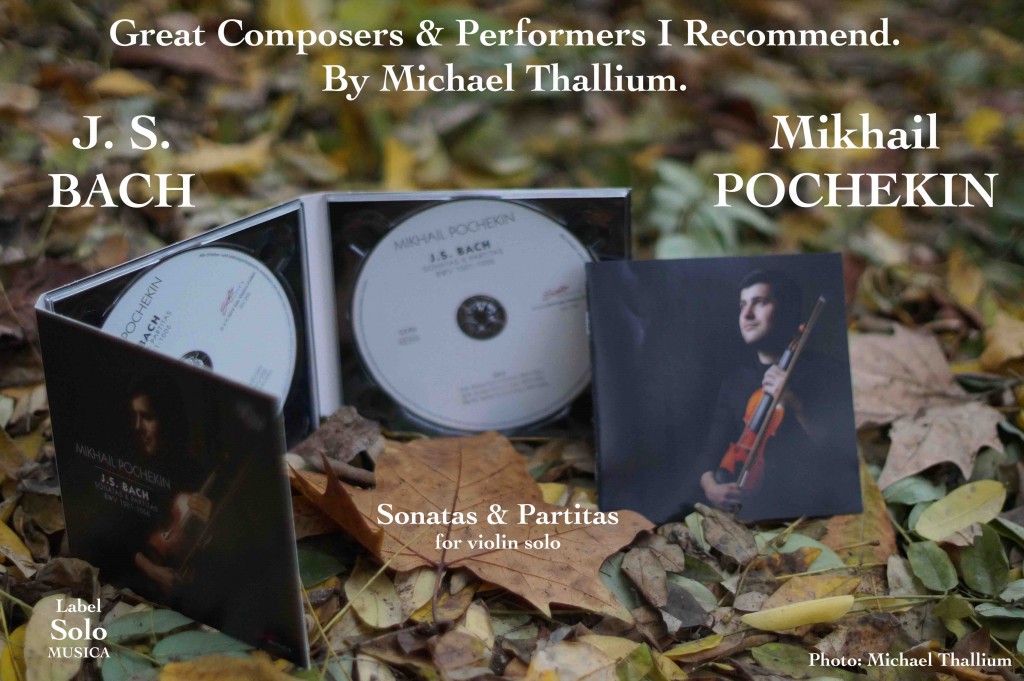
Next Sunday May 26th 2019 at 7:00 pm, the Russian-Spanish violinist Mikhail Pochekin and former student at the prestigious Escuela Superior de Música Reina Sofía in Madrid will offer a recital at Ateneo de Madrid to present and celebrate his acclaimed double CD “J.S. Bach – 6 Sonatas & Partitas for violin solo BWV 1001-1006″ (tickets for just 5€). This is a unique opportunity for people visiting Madrid to enjoy the works of Johann Sebastian Bach performed by a violin virtuoso like Mikhail Pochekin.
PROGRAMME
Johann Sebastian Bach (1685-1750)
Sonata no. 1 in G minor, BWV 1001
I. Adagio
II. Fuga
III. Siciliana
IV. Presto
Partita no. 2 in D minor, BWV 1004
I. Allemanda
II. Corrente
III. Sarabanda
IV. Giga
V. Ciaccona
Partita no. 3 in E major, BWV 1006 I. Preludio II. Loure III. Gavotte en Rondeau IV. Menuet I V. Menuet II VI. Bore VII. Giga
His double CD, released at the end of January 2019 on Solo Musica, has been acclaimed by different international newspapers such as the German Süddeutsche Zeitung (with reviews by such prominent critics as Harald Eggebrecht and Reinhard Brembeck) and different music magazines around Europe: Pizzicato, Concerti, Audio. In Spain, Mikhail Pochekin’s CD was recommended as “February No. 1″ by Ritmo, as “April 5 Stars” by Melómano and it has been praised by the prestigious classical music magazine Scherzo in May 2019. His double CD has also been highlighted as the best album of the week or the day by different radio stations such as ORF/Ö1 in Viena, Orpheus in Moscow, HR2 in Frankfurt or NDR-Kultur in Hamburg.
Over the first months of 2019, “J.S. Bach – 6 Sonatas & Partitas for Violin Solo BWV 1001-1006″ has been presented in concert in Berlin, Hamburg, Munich and Moscow. For the recording of this album, Mikhail Pochekin played a violin built by the famous Venetian luthier Francesco Gobetti in 1720.
“I first met Mikhail Pochekin on a cold Sunday morning of snow in Madrid. It was back in February 2018 and I had to cover for the Spanish music magazine Scherzo Pochekin’s recital accompanied by the great pianist Yury Favorin —his Prokofiev’s interpretations have no equal— at Fundación Juan March. When the recital was over, I made for the artist’s dressing room and Mikhail, with those cat eyes of his, as profound as profound his music performances are, talked about his brother Ivan with admiration. They both had just recorded a CD and he gave me a copy as a present to listen to. And that was what I did: listening to it attentively and with delight. After some months touring around Russia and Europe, destiny made us meet again in Becerril de la Sierra, a little town near Madrid, Spain, where Pochekin’s parents have been living for some years already. Mikhail invited me to see his dad’s workshop. Yuri Pochekin is an internationally renowned luthier who has just turned 70 this year. Most of the violins with which the Pochekin brothers play at their recitals have come out of this little workshop. Mikhail Pochekin is a violinist of exciting musicality, impressive technique and deep musical insight; intelligent —he speaks Russian, Spanish, English and German—, friendly and enthusiastic. When it comes down to music, things are clear to him. One of his aims is to bring classical music closer to people of all walks of life.
Mikhail Pochekin’s most important project so far is Bach. He has just recorded the whole sonatas and partitas for violin by the German composer, which will be soon released as a double CD. Playing these works is a challenge for any violinist. And it has been a long and difficult way for Mikhail as well. He has been discovering his own voice over the years: “first you learn this extremely difficult pieces, then you make them your own and then your heart takes over them and the music grows within you”, he says. Mikhail thinks classical music will always stay with us: “Bach does not physically exist since 1750, but his music will exist as long as there are human beings on this planet Earth. We do not only enjoy music, music also makes us think about life, think about eternity. Somehow, we musicians are always playing eternity. And we people are especial thanks to artists like Bach, Mozart, Schubert, Shakespeare, Pushkin or Rafael. And this is what makes us different from animals.” – Michael Thallium
Here you are the official video recorded at St. Ludwig in Berlin-Wilmersdorf:
You, dear reader, if you have just read these lines, and if you ever have the chance to see Mikhail Pochekin play live, come up to him —don’t be shy— and talk to him, let his profound cat eyes take over you. You will see that behind the artist who plays eternity and moves you with sounds, there is also a human being like you and me, a human being who loves to talk with words, someone who is close and friendly.
Andrea Casarrubios, cellist, pianist and composer.
I get up on a Sunday morning as usual. I go out for an early breakfast with my father, a ritual that these days I can only do at the weekends. It has been a while since I last had a look at the classical music new releases section on iTunes. I decide to take a look when I get back home. For different reasons, there are three CDs recently released in February 2019 which draw my attention: the pianist Kirill Gerstein performs the Concerto in C major, op. 29 by Ferruccio Busoni (1866-1924) on Myrios Classics; the picture of some Camille Pépin, a young French composer I have never heard of, appears on the cover of Chamber Music, a CD on Elegant People; then I happen to see another cover of a CD on Odradek Records. The title “Caminante” (Wayfarer) and the name Andrea Casarrubios catch my attention. I have never heard of this woman either. I google her name on the Internet. I find out that Andrea Casarrubios is a Spanish cellist. She also studied piano as a child and later, when she moved to the United States, she studied composition with no more no less than John Corigliano! In fact, the works in the album Caminante have been written by Andrea Casarrubios herself. I keep looking up on some web pages and I can read that she was born in San Esteban del Valle —a little village in the province of Avila, in Castille, Spain— in 1988. She was brought up in Arenas de San Pedro. When I read “Arenas de San Pedro“, I recall the times when, as a child, my parents use to take me to a natural swiming pool of freezing water in Arenas de San Pedro. Who knows, I might even have come across Andrea there when she was little! I also happen to read that Andrea Casarrubios is quite successful in the United States and that she is living now in New York. I don’t know if it was because of my memories of that swimming pool or because of the title Caminante or just because I found it really interesting that Andrea Casarrubios has a successful career in the States, the thing is that I ended up requesting Andrea’s friendship on Facebook and purchasing her CD. Actually, I am listening to Caminante while I am writing these lines.
The first piece is the one that gives the name to the CD, Caminante. It was written in 2014 for cello and choir. It is based on a famous poem by Spanish writer Antonio Machado (1875-1939): A path, Wayfarer, there is none / As you walk on, the path is done. The piece starts with the cello singing a kind of lament, as if Andrea would walk her fingers along the strings of melancholy creating a beautiful melody. Then joins the choir singing the verses of Machado. On the booklet which accompanies this recording, I can read Andrea’s own words saying that she dedicates this work to Alicia Rodríguez Blanco, who guided and supported her throughout her studies and trips abroad.
The next work is Speechless, composed for cello and percussion (vibraphone, cymbal and marimba) duo. It starts with the smooth sound of vibraphone later joined by the cello on lower strings. This work seems to be a journey which starts by the end and it tries to give an answer to the following question: what does it mean to have a voice? Andrea wants this piece to be an experience based on the dialogue of the inner voices of one’s self, following that maxim of never visiting the same place twice. In her search for this vital centre, it looks as if she would be sculpting the music backwards, as if you took off the layers of a finished painting until the first trace, the essence, appeared. Garret Arney is the percussionist who embarks on this Speechless journey towards the essence in a harmonic dialogue with Andrea’s strings and bow.
In Crisol (Melting Pot), Andrea Casarrubios shows her skills and exquisite musicality on the piano. Crisol is an improvisation based on motives from the Sonata no. 39 by Haydn (1732-1809). In words of this Spanish composer and musician, the improvisations begin with my own harmonic and textural language, soon to melt into a musical world from the Romantic era. The music walks through a jazz-like moment and then unveils the purity and simplicity of Classicism, with the second movement of Haydn’s Sonata No. 39, which is harmonically linked to his last movement, the Finale. In fact, the work following Crisol is the Finale of Haydn’s sonata; both blend beautifully as if it were just one and only musical work.
Next piece is Maktub, a trio for cellos. Andrea wrote it while she was living in Los Angeles for the 6th Luigi Boccherini Festival of Arenas de San Pedro, Spain. In Maktub, the cellists Thomas Mesa and Ismar Gomes go along with Andrea Casarrubios on another musical trip full of the flavours of different cultures from Asia, America, Africa and Europe. Maktub finishes with a reference to the last movement of the Sonata opus 109 of Beethoven (1770-1827). Andrea dedicated this work to her parents. How proud they must be of the fabulous artist their daughter is!
The last work of this album is La Libertad se levantó llorando (Liberty rose weeping), a duo for violin and cello written by Andrea on request from the violinist Emily Daggett Smith, who also plays on this recording. It is based on a Pablo Neruda’s poem of the same name. The violin and the cello start a dialogue in a musical cry full of the agresiveness and the vulnerability of the words of those who fight for freedom in the world. Eight and a half minutes into the work, you can hear a female voice reciting Neruda’s poem and I assume it is Andrea’s voice.
With this album, Andrea Casarrubios has shown, with great sensitivity and personal touch, that she is a wayfarer of the strings and the world. Using her fingers and compositional imaginación, Andrea has taken music and emotions closer to the ears of people who dwell upon this planet Earth. Music, dear listener, there is none. As silence walks on the music is gone.
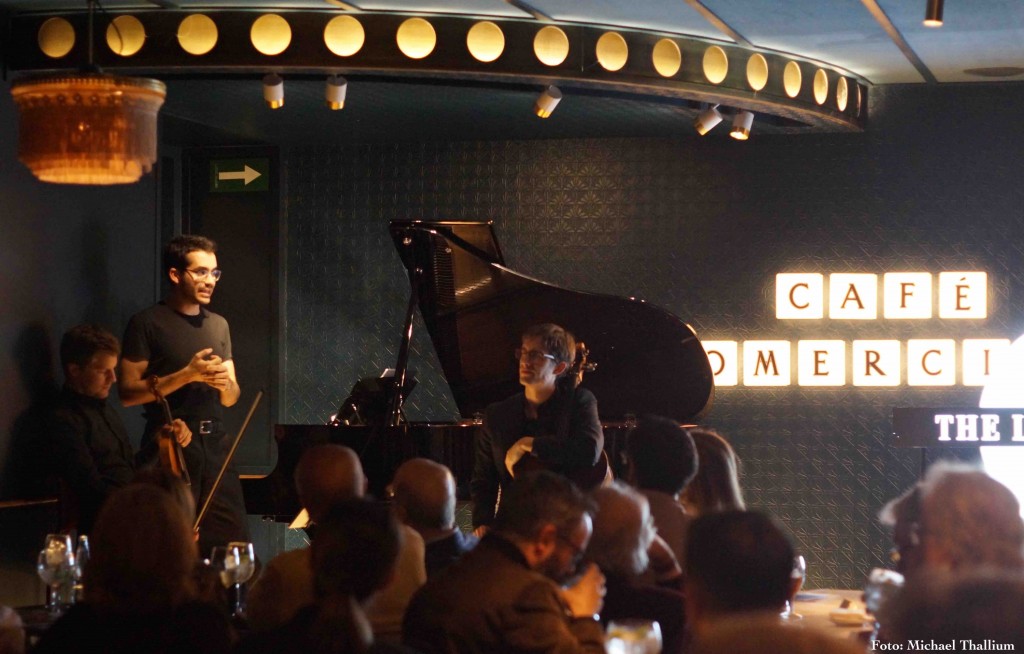
Madrid. Café Comercial, 05/12/2018. Trio VibrArt: Miguel Colom (violin), Fernando Arias (cello) y Juan Pérez Floristán (piano). Works of Franz Schubert, Trio No, 2 in E flat major, D929; Dmitri Shostakovich, Trio No. 2 in E minor, op. 67.
By definition, it is impossible to grasp what is ungraspable. And that is what happens “just a little” with that ephemeral art which is music: grasping it becomes impossible. However, —even if we cannot grasp it— that “just a little” is what makes us enjoy music “just a lot”, instant by instant, as time passes by, when the sound waves, by some kind of organic magic, get transformed in our brains and turn into beautiful sounds and harmonic melodies which make us vibrate in tune. Very, very few times that succession of sonic instants turns into truly vibrant art. And that is precisely what the Trio VibrArt achieved at Café Comercial in Madrid. There are moments when you become aware of the transcendence of what you are witnessing, when you realize something is far beyond mere entertainment. I think I am not mistaken by saying that those of us who were witnesses of the Trio VibrArt recital would agree and state that Miguel Colom (violin), Fernando Arias (cello) and Juan Pérez Floristán (piano) created not just good, but exceptional and unique vibrant art. They raised the bar beyond the immense height —and hard to match— of the two composers they performed: Schubert and Shostakovich.
The quality of The London Music N1ghts cycle —sponsored by The London Nº 1— at Café Comercial is growing with each recital. And this is a real challenge for both the artists to come —they are expected to rise the challenge— and the audience attending those recitals —they do not want to be let down. The alma mater of the cycle, Benjamín G. Rosado, hit the bullseye by bringing in the Trio Vibrart to Madrid. On the programme, two chamber music works by two great composers with unmistakable trademarks: the Trio No. 2 in E flat major D929 by Franz Schubert and the Trío No. 2 in E minor op. 67 by Dmitri Shostakovich. These two works are separated by 116 years, but closely connected by the presence of death: Schubert’s work was written in 1828, the year of his death, and it is a real swan song; Shostakovich’s work was written in 1944 amidst the horrors of World War II, it is an anguished song evoking the Jewish holocaust.
Miguel Colom (violin), Juan Pérez Floristan (piano), Fernando Arias (cello).
The first part of the recital started with Juan Pérez Floristán as a master of ceremonies. With that particular high pitch and delicate voice of his —something striking given the strength and powerful character of his hands on the piano—, he explained the first of the works to be performed: Schubert’s Trio. It is a quite well known piece —Stanley Kubrik used its second movement in his 1975 film Barry Lyndon— by the audiences. It has four movements: Allegro, Andante con moto, Scherzo and Allegro moderato. It is a work of exquisite melodical beauty and expressive power. In their days, Schumann and Brahms admired this trio above Beethoven’s trios. It was also one of the last works Schubert could see performed before his passing away. It lasts between 40 to 50 minutes. The Trio VibrArt performed this work with a mental and sentimental inner vision, full of clearness and definition, which surpassed the greatness and highness of the schubertian melopoeia.
The second part of the recital was introduced once again by Juan Pérez Floristán in his own distinct voice. It was an invitation to an epiphany and a catharsis. Shostakovich’s work in four movements, full of Jewish melodies and dances, starts with a delicate and melancholic singing of the cello, in an extremely high pitch —all harmonics and really difficult. Then the violin joins in, in a very low pitch and, finally, the piano accompanies them both. The Trio VibrArt achieved the catharsis: expressiveness, anguish, contrast, dynamism, beauty, sentiment, power, struggle, rapture, delicacy… And lo and behold the epiphany: the three Spanish musicians manifested themselves as a real world reference in trio chamber music.
The enthusiastic applause of the audience, aware of the exceptional performance they had just witnessed, had its reward when the cellist Fernando Arias —interestingly, also with a high pitch and delicate voice that does not match the low pitch and powerful sound of his cello— announced that, as an encore, they would be playing one of Federico Mompou’s Scenes from Childhood arranged for the trio by Juan Pérez Floristán. This short arrangement showed, once again, the musical genius and penetrating intelligence of Juan Pérez Floristán. The Trio VibrArt: vibrant, epiphanic and cathartic!
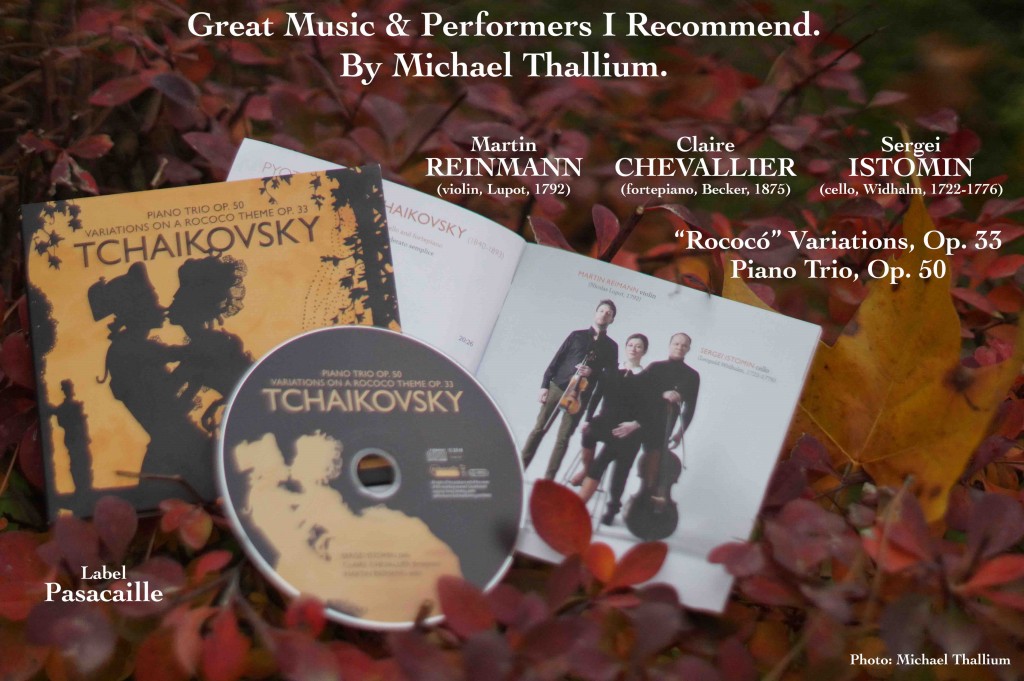
Variation on a Rococo Theme & Piano Trio op. 50 by Tchaikovsky performed by Sergei Istomin (cello), Claire Chevallier (fortepiano) and Martin Reinmann (violin). Label Passacaille.
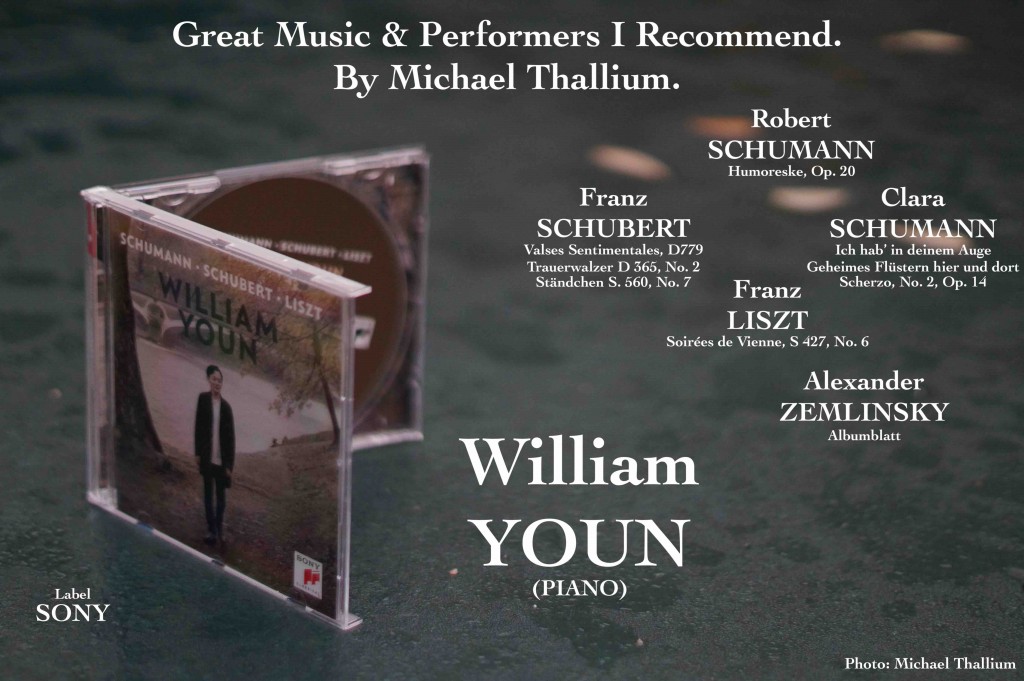
Works for piano solo by Clara & Robert Schumann, Schubert and Liszt performed by William Youn. Label Sony.
The first thick digit, just a simple finger they call thumb.
It is that strong finger which shows all its strength and greatness
when it is lifted up. It is the finger that says:
EVERYTHING is going to be ALRIGHT.
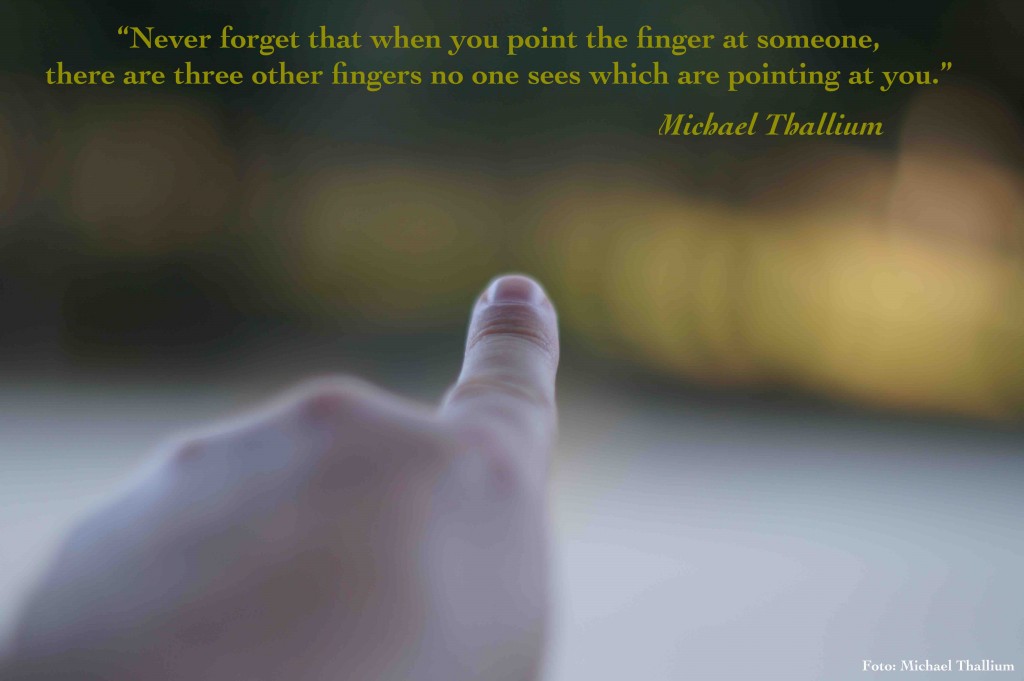
Never forget that when you point the finger at someone,
there are three other fingers no one see which are pointing at you as well.
“There are books in which the footnotes, or the comments scrawled by some reader’s hand in the margin, are more interesting than the text. The world is one of those books.” ― George Santayana (1863-1952)
What is life? This is an old question that many of us human beings have been asking ourselves for centuries. Philosophers, scientists, artists, writers, ordinary people… And lots of answers have been given as well; some convincing, some less convincing and some others completely unsatisfactory. But in the end it all comes down to living… and living well. No-one likes problems or having trouble going through life. Unfortunately, we all come across problems in our ways and try to find solutions to them. The thing is that sometimes solutions come hard and it may even seem impossible to find them no matter how hard you try. So, what to do when you have been struggling to change things in your life and you still end up pretty much in the same place? What to do when it seems no transformation is possible? Yes, I know, you may be thinking that there is always “transformation” —something Heraclitus said thousands of years ago—, but I mean that “transformation” you really want in your life. Well, here your are a tip: know your limitations and accept them. This is a good start, but not enough if you still want to transform your life. That is why I chose that quote of Santayana. Let’s assume life is just a book we cannot change. Sometimes its text may be so dull and boring that we want out of our particular chapter. But the text is written in indelible letters and either we keep reading the rest of it or quit, and by “quit” I mean “die”. So, the only alternative we have left is to use our resources to scrawl comments in the margin or add footnotes to make our lives more interesting —and remember, the first person to whom your life must be more interesting is YOU. And this is my suggestion: if you want to transform the book of your life, just start by writing in the margin and become the world you want to live in. Then you may even realize that the assumption that you cannot change the book of your life is wrong.
Now, don’t be fooled. Using your resources requires effort and perseverance. It is nothing magical, but practical, that is, you need practice, practice and practice.
I am writing these lines while I am listening to Musica Ficta perform the Requiem by Tomas Luis de Victoria. I chose this music for practical reasons. Victoria was born in the province of Avila. He was a catholic priest and arguably the greatest Spanish composer of all times; he spent part of his life in Rome and died in Madrid in 1611. He became a choirboy at Avila Cathedral were he was trained as a musician before leaving for Rome, where he masterfully wrote the greatest music. So, what? What are those practical reasons? Let me first tell you that it is not Tomas Luis de Victoria the one I want to write about, but another man born over 250 years after Victoria’s death: George Santayana. So… what? What is still practical about your reasons? Well, Santayana was born in Madrid and spent his early childhood in Avila before moving to the United States, where he became a philosopher, an essayist, a poet and a novelist. So, what? Santayana loved cathedrals and died in Rome. Can you connect the dots? Madrid, Avila, Rome…
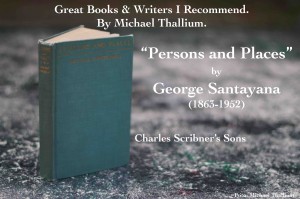
I think I should first explain how I came across George Santayana —quite a chance encounter by the way—, whom I had never heard of in my life. Of course, since he died in 1952, I do not mean I met him personally unless I were dead —knock on wood!— and had that strange power of coming back to life from the afterworld. No, my encounter with him was a bit more intelectual than physical. It was reading Invitation to Philosophizing Following The Spirit and Writings of Antonio Machado (“Invitación a filosofar según espíritu y letra de Antonio Machado”) by Juan David García Bacca —another Spanish philosopher— that I read the name “Jorge Santayana”. It caught my attention, because I had never heard of him before, and my attention turned into curiosity when I found out about him and got to know that Santayana had written all of his books in English. Actually, he changed the Spanish name “Jorge” —roughly pronounced ‘Horhey’— by “George” and he is considered one of the greatest American writers of the 20th century. However, he always remained Spanish. That was striking to me! Was it possible that a Spanish born in 1863 would turn into an American man of letters? After a little research I did, I manage to buy one of his books, Persons and Places, at Menosdiez, a little second-hand bookshop in Madrid downtown. I wanted to try and see whether he really was such a great writer as they said. Santayana had been a nominee to the Pulitzer Prize for his novel The Last Puritan (1936), but he was never awarded with the prize, apparently because he was not an American citizen and had always kept his Spanish passport.
And what a great writer he is indeed! I loved Persons and Places, an autobiography written at his late 70s where he beautifully describes an amazing life of academical achievements, travelling and philosophy. The book is divided up into sixteen chapters where he speaks about his origins in Spain, his teenage years in Boston, his achievements at Harvard University as an adult and his later return to Europe when he quit Harvard at age 48.
George Santayana may be the writer —not only prose but poetry as well, see A poet’s testament and O World— who best wrote about Spain in English. And for sure reading Persons and Places is a great exercise for those of us who want to master the English language and the knowledge about life in the late 19th and early 20th centuries in the United States, Spain and Europe. In all that regards himself, his thoughts, or his happiness, Santayana crossed a desert more than once in his life; so that when he looks back over those years, he sees objects, he sees public events, he sees persons and places, but he doesn’t see himself. His inner life, as he recalls it, seems to be concentrated in a few oases, in a few halting places, Green Inns, or Sanctuaries, where the busy traveller stopped to rest, to think, and to be himself. Now you may understand the practical reasons why I chose the music of Victoria while I was writing these lines. If you don’t, don’t worry, maybe someday you too will connect the dots.

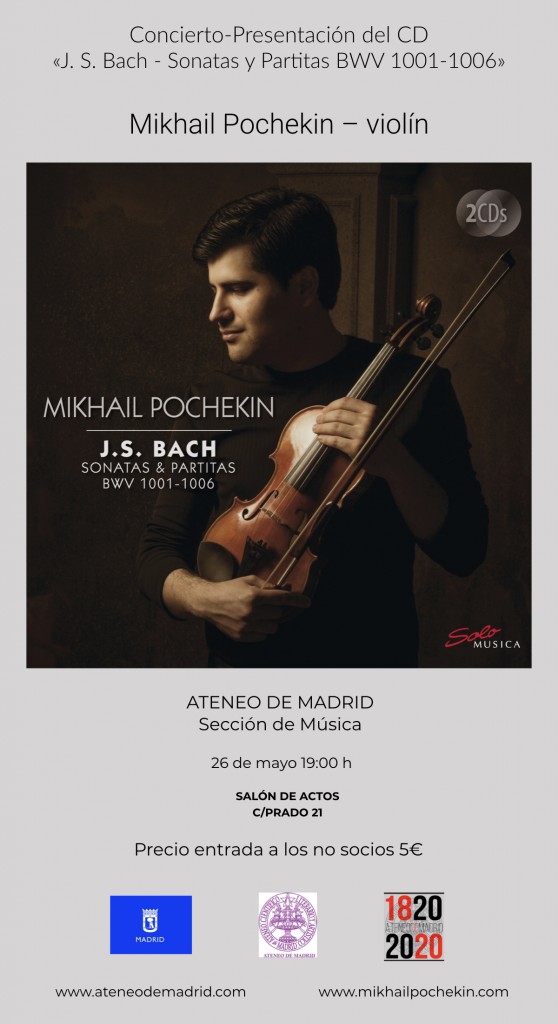 Next Sunday May 26th 2019 at 7:00 pm, the Russian-Spanish violinist Mikhail Pochekin and former student at the prestigious Escuela Superior de Música Reina Sofía in Madrid will offer a recital at Ateneo de Madrid to present and celebrate his acclaimed double CD “J.S. Bach – 6 Sonatas & Partitas for violin solo BWV 1001-1006″ (tickets for just 5€). This is a unique opportunity for people visiting Madrid to enjoy the works of Johann Sebastian Bach performed by a violin virtuoso like Mikhail Pochekin.

 What is life? This is an old question that many of us human beings have been asking ourselves for centuries. Philosophers, scientists, artists, writers, ordinary people… And lots of answers have been given as well; some convincing, some less convincing and some others completely unsatisfactory. But in the end it all comes down to living… and living well. No-one likes problems or having trouble going through life. Unfortunately, we all come across problems in our ways and try to find solutions to them. The thing is that sometimes solutions come hard and it may even seem impossible to find them no matter how hard you try. So, what to do when you have been struggling to change things in your life and you still end up pretty much in the same place? What to do when it seems no transformation is possible? Yes, I know, you may be thinking that there is always “transformation” —something Heraclitus said thousands of years ago—, but I mean that “transformation” you really want in your life. Well, here your are a tip: know your limitations and accept them. This is a good start, but not enough if you still want to transform your life. That is why I chose that quote of Santayana. Let’s assume life is just a book we cannot change. Sometimes its text may be so dull and boring that we want out of our particular chapter. But the text is written in indelible letters and either we keep reading the rest of it or quit, and by “quit” I mean “die”. So, the only alternative we have left is to use our resources to scrawl comments in the margin or add footnotes to make our lives more interesting
  I am writing these lines while I am listening to