
Sorry, this entry is only available in Español.
|
Sorry, this entry is only available in Español. Article written by Greg Satell. To see the original article, please visit Greg’s web page: www.digitaltonto.com  Greg Satell - DigitalTonto Do you have a big idea? Is it really, really, really big? Huge even? We are idea machines. We come up with new ones constantly, usually at odd times and in strange places. There’s probably nothing more romantic than someone in love with an idea. We tend to glorify flashes of genius because it’s exciting and makes a good story. However, many people with great ideas have been lost to history, while some have become famous for ideas that others had too. For better or worse, it takes more than just a clever notion to make a difference in the world.
Gregor Mendel’s Big IdeaGregor Mendel, an Austrian monk, had a big idea. He thought that there were specific laws that governed how we inherit characteristics from our ancestors. He was so sure of his idea that he spent 7 years researching pea plants, wrote a paper and presented it to the local scientific society. He then went back to his duties at the abbey and was promptly forgotten. It wasn’t until decades after his death that his idea came to the fore and he became considered the “father of genetics.” It was helped along by Charles Darwin’s theory of natural selection. Of course, Darwin wasn’t the only one who thought of that. He published On the Origin of the Species only after it became clear that Alfred Russel Wallace had the same idea. Thomas Kuhn, in his classic The Structure of Scientific Revolutions, pointed out that, although history usually records that one person in connection with a particular breakthrough, a closer look usually reveals that several people could rightly claim credit for important discoveries. We all know Albert Einstein, but few have heard of David Hilbert, who published his theory of general relativity at almost the same time. Would it have made a big difference if the order had been reversed? Google’s Small IdeasGoogle is famous for having built an enormous company based on one big idea, theirPageRank algorithm, which ranks web pages based on the links they receive from other web sites. However, Jon Kleinberg of Cornell published a similar (and many believe superior) idea called the HITS algorithm around the same time. The difference was that Larry Page and Sergey Brin started a company, hired lots of engineers and generated thousands of smaller ideas that improved search further. Today, everybody knows how PageRank works, but Google is still the search leader in almost every country and language. Of course, they didn’t make much money with until they developed their AdWords and AdSense programs. That was a truly inspired idea, but it wasn’t Google’s. It was developed by a company called Overture, which was acquired by Yahoo, neither of whom made much money in search. Why Apple Isn’t a Disruptive InnovatorApple is revered for its great ideas. They do a superior job of marketing themselves as a company that inspires us to “Think Different,” like in this fantastic ad. However, it’s hard to think of any idea that Apple originated. They certainly didn’t invent personal computers, but the Apple II was a breakaway success. Xerox invented the graphical user interface, but the Macintosh brought it to consumers. The story is similar for digital music players, smart phones and tablet computers. Much like Google’s search, we don’t love Apple’s products because they are original ideas, but because they work so well. While management gurus like to crow on about first mover advantages, it is often the fast (and sometimes not so fast) followers who achieve the greatest success. What’s interesting is that Apple is often credited with pioneering categories that they didn’t originate, but perfected. When ideas are successful, we call them memes (a concept, incidentally, that was arrived at almost simultaneously by E.O. Wilson andRichard Dawkins). Of course, when brainstorms aren’t successful, we don’t have a fancy name for them. They’re just dumb ideas. Networking Idea SpacesThe reason that big ideas often don’t amount to much is that no idea can make it on its own. Just like cars need roads and gas stations, suburbs need cars and shopping malls need suburbs, ideas become powerful when they interact with other ideas. Technology evolves when ideas combine. Richard Ogle calls this networking idea spaces. Matt Ridley refers to it as ideas having sex. Corporations, which defend their ideas with patents and armies of lawyers, are becoming more comfortable with the concept of open innovation because no idea can truly stand on its own. So, while ideas are important, it’s almost impossible to tell in advance which ones will be valuable, because that will depend on the context into which they arrive. Take a closer look at any big idea and, undoubtedly, you will find that its prominence is due to a collection of smaller ones. Greg Satell Yesterday, Friday 13th May 2011, at Ateneo de Madrid, we had our 7th Coachtulia. On this occasion it was based on the excellent book by Jennifer Sertl and Koby Huberman: Strategy, Leadership & The Soul“. 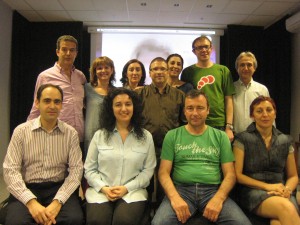 Standing from left to right: Rafa Saiz, Pilar Fernández, Noemí, Michael Thallium, Carla Franco, Fran, Paco Torres. Sitting: Jesús Iglesias, Victoria Caro, José Luís Romero, Deme Salas With this coachtulia, we were connecting four communities: New York, Madrid, London and Israel. Cheers to connectivity and leadership! We discussed about the concept of “transleadership” and asked ourselves how to become “transleaders”. Since Jennifer was not be able to connect via Skype at the time we held our Coachtulia in Madrid, we recorded her message, which we would like to share with you here. Cheers Jennifer! Michael Thallium Reading the fantastic book by Josh Kaufman, The personal MBA, I have found an excellent and simple definition of the word “business” and I would like to share it with you all:
So, every successful business consists of the following ingredients:
Take away one of this five ingredients and you will have other than a business. Every ingredient is essential and universal. Are you successful with your business? Michael Thallium Article written by Dr. Pamela Gerloff. Originally published in The Huftington Post
I do understand how those who have suffered from the events of 9/11 may feel relieved, even happy, to have “closure” after 10 years of waiting for “justice to be done” — and I don’t quarrel with such feelings. Closure is a natural yearning and can certainly help people move on from serious trauma. And feelings are feelings. If you feel joyful, you feel joyful. But celebration is not in order, no matter what your feelings of elation. Here’s why. We are not a peaceful species. Nor are we a peaceful nation. The celebrations of this killing throughout the country draw attention to these facts. The death of Osama bin Laden gives us an opportunity to ask ourselves: What kind of nation and what kind of species do we want to be? Do we want to become a species that honors life? Do want to become a species that embodies peace? If that is what we want, then we need to start now to examine our own hearts and actions, and begin to consciously evolve in that direction. We could start by not celebrating the killing of another. It is hard not to think that some of the impulse to celebrate “justice being done” may also contain a certain pleasure in revenge — not just “closure” but “getting even.” The world is not safer with Osama bin Laden’s violent demise (threat levels are going up, not down), so no cause for celebration there; evil has not been finally removed from the Earth, so no reason for jubilation on that count. The War on Terror goes on, so there is no closure in that regard. The truth is that “celebrating justice” when one person is killed — as happens regularly in the gang wars of American cities — only incites further desire for revenge, which, from “the other side’s” viewpoint, is usually called “justice.” Think of it. If a leader in our country were killed by another government in the manner in which Osama bin Laden was killed, as “justice” for his acts of aggression in the War on Terror — and people from that other country were shown proudly chanting the country’s name, singing their national anthem, and demonstrating in the streets — Americans would likely feel more sickened than joyful, don’t you think? The impulse to celebrate a death depends on what side you’re on. We will only have peace when we stop the cycle of jubilation over acts of violence. Who will stop the cycle? If not us, who? If not you and I, who will it be? “Do not ask for whom the bell tolls. © 2011 by Pamela Gerloff Sorry, this entry is only available in Español. (article written by Rachel Flowers)
I still like the live versions of some of these songs better, because they are played with energy, and with real instruments. The day after I got my new flute, I played a piano and flute interpretation of Keith Emerson’s piano concerto, and Just Because. One day, when mom was home from work, I sat down at the piano, and played her these songs in a medley like the album, but not the entire songs. The day after I made my piano and flute video of Keith Emerson’s piano concerto, I thought about recording Just Because, then I thought about recording a medley of most of the songs. I took ideas from both studio and live versions. On the opening, Prelude, (originally played on keyboard strings and cello) I played the melody on the flute and piano, more like the live version. I played every song except Glamour and Pain, and Happyland, but parts of Happyland (the chorus) and Love Got Lost (the middle section before the last chorus) were featured in the prelude. I quoted a lot of ideas from the live version more than the studio version. I played excerpts of the songs, just like what saxophonist, and flute player Najee did with his version of Stevie Wonder’s Songs in the Key of Life. After the prelude, I played the upbeat percussion part to the second song (with an angry name and aggressive lyrics), but I enjoy the music to it. There’s just something about the percussion section in the live version, and the song is played more dramatically than the studio version. I took a piano quote from the live version, and played it on the flute, and I had fun with it. I wanted to continue with a flute solo, but it was difficult for me to play both instruments at the same time, so I played a little piano going in to Stranger Than You, to the middle eastern, opera-like Why. I skipped Glamour and Pain, not because I don’t like it, but I couldn’t find a way for me to put the song in the medley. Although it does have one word in the second verse, I still like the girl who sings it live better than the studio version. But I did find a way to go into Dear Mom. I improvised a little during half of the verse on Love Got Lost, but played part of the chorus, going into Just Because. On the studio version of Just Because, it starts with a fugue played by a string quartet and the live version starts right at the song. I started with the last few parts of the fugue, (piano style), than I went to the live version. This is the dramatic part of the song. I decided to play the melody almost like the piano player from a contemporary jazz trio called The Bad Plus. I played the first verses and chorus with jazz-like voicings. During the second verse, I sang and played flute at the same time, to try to play a musical version of the words, and I also played the string part, then switched melody with piano and flute. On the original album, the next song is Happyland, but for my arrangement, I decided to go to the last song, Stay, my favorite song. I played the first part of the melody on the flute, then played the rest of it on piano. I also quoted a couple of Emerson piano runs, which is featured on parts of this medley. I remembered I smiled after I finished playing. This is my instrumental piano-flute take on these songs, and I had a lot of fun playing them. Rachel Flowers No comments. Just another great talk at TED.com! Michael Thallium Early this morning I read a post by @DigitalTonto on Twitter and I happened to know about The Ad Contrarian and The Cost of Being First, a really interesting article by Bob Hoffman, ceo of Hoffman/Lewis advertising in San Francisco and St. Louis. Bob is former ceo of MOJO USA and ex-president and creative director of Allen & Dorward. He is the author of the book The Ad Contrarian and the blog with the same name. And here, with the permission of Bob Hoffman, an excerpt of the above mentioned article:
So, what do you think? Michael Thallium |
|
|
|
Copyright © 2026 Michael Thallium - All Rights Reserved |
||
 While the killing of Osama bin Laden is being enthusiastically celebrated throughout America and parts of the world, to say that such merriment is out of order will surely be considered heresy. Nonetheless, I’m saying it — because it needs to be said. What I am tempted to say is this: Get a grip, celebrators. Have you so little decency?
 I remember one day after school, I asked my mom’s friend if I could listen to the studio version of