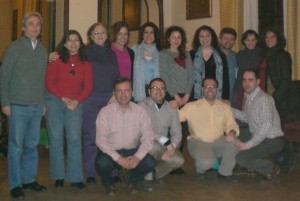
It was a rainy day of April in Spain. I got up early because I had an appointment and a long trip to go by car from Móstoles in Madrid to Muriedas in Cantabria, in the north of Spain. I was meant to meet the person I had seen play the piano with the Ensemble of Cadaques at the Centre for Dissemination of Contemporary Music in Madrid three years before. Back then, I decided to request his friendship on Facebook and we have been in touch ever since. However, that morning of April would be the first time we met. I wanted to interview him. And that was my only chance, because he would be going to Holland on the following day and, after that, to Indonesia for a couple of months, not coming back to Spain until August. So I took my chance: I would be meeting maestro Ananda Sukarlan.
Ananda is based in Spain, but he often travels to different countries in the world, above all to Indonesia, where he was born. His activity as a composer and interpreter have led him to get involved in different projects both in Spain and Indonesia. He collaborates with Spanish composer David del Puerto and the Open Music Foundation based in Urueña, the Book Village in Spain. Ananda writes music for disabled children as well. In Jakarta, his hometown, he established The Indonesian Classical Music Foundation to help underprivileged as well as disabled children through music and arts.
When I arrived in Muriedas to Ananda’s house, it was as if I would have known him for a life time. We talked about many things. We spent six hours together and I met Raquel, his wife, and Alicia, his daughter, to whom Ananda dedicated his Alicia’s First Piano Book.
Here you can see an excerpt of the interview:
(If you wish to see the whole interview, please HERE):
I have already written about the importance of music for the human brain in some other articles. I use it when I do coaching, in my seminars, workshops or when I teach languages. That may be the reason I felt total conexion when Ananda told me about his foundation, because one of my life projects is to create an institution to boost creativity and intelligent effort in Asia, Africa and Latin America.
I know Ananda and I will collaborate in some project someday. He does not know yet, but I do. And I am sure we will see each other soon again.
Almost a week ago, I was at a fantastic recital. The pianist was Federico Lechner. I had met him by chance hardly a week earlier at another fantastic recital by the Japanese pianist Asuka Nakamura. Federico was sitting in the audience just behind us. During the break, my friend and pianist Julio César Setién introduced me to Federico (I had never heard of him before) and this is how I got to know that he would be playing in the same place one week later: Los miércoles de cámara organised by my friend and violinist Shahar Rosenthal. I said to Federico “We’ll come to your recital next week. See you there”. And that’s what we did!
Federico is not only a great pianist but a really nice person.
A week later, accompanied by the person who had introduced me to Federico, I came to see him play. And it was simply fantastic. In the second part of the recital, Federico started improvising a la Ligeti on the notes that we in the audience were telling him. First on two notes, then three, five, seven and nine notes. Here you are a sample:
This is a monthly column on becoming a great human being and has two opinions on the subject from eastern and western parts of the world namely Dr Amit Nagpal from India and Michael Thallium from Spain. If you wish to read more articles on this topic, please visit The Joys of Teaching by Dr Amit Nagpal.
CONSCIOUSNESS MAKES US GREAT Amit Nagpal’s opinion
Dr Amit Nagpal is a Personal Branding Consultant & Global Success Coach. He is based in New Delhi, India and specializes in personal branding with a holistic touch. His philosophy is, "Enlarge as a Human Being, Excel as a Social Media Being and Evolve into a Personal Brand(ed) Being.
Does it mean since we are conscious till we die, so we are great by having a soul or the consciousness of being alive? No, it is not simple as that.
Deepening (or raising, if you prefer it that way) our consciousness levels makes us great. To start this journey, let us understand the different levels/types of consciousness. Different schools of thought may have differing views on this but the crux is almost similar. Let us take two schools/philosophies which are easy to understand viz. David R. Hawkins (levels of consciousness) and Nichiren Daishonin Buddhism (types of consciousness).
David R. Hawkins in his book Power vs. Force talks of a hierarchy of levels of human consciousness. You can also find out your level of consciousness, based on your current life situation. From low to high, the levels of consciousness are: shame, guilt, apathy, grief, fear, desire, anger, pride, courage, neutrality, willingness, acceptance, reason, love, joy, peace, enlightenment. While we keep shifting from one state to other, usually there’s a predominant state, in which we stay most of the time.
‘Courage’ is the first positive level and if you are reading this post, you must be at least at this level since you are aspiring for personal growth. You become disciplined and start looking for productivity increase when you reach the level of ‘Willingness’. You accept the responsibility of your role in the world when you reach the level of ‘Acceptance’ and awaken to your purpose of life when you reach the level of ‘Love’.
Eckhart Tolle describes the state of ‘Joy’ consciousness in The Power of Now. Just being around people at this level makes you feel ecstatic. The person at this level is guided by synchronicity and intuition. There’s no need for goals/targets and plans — since one is operating at a much higher level. Then there are levels of ‘Peace’ and ‘Enlightenment’ which are reached only by the people like Jesus, Buddha, Krishna, Guru Nanak and Mohammed. For a more detailed description, I suggest you to visit Steve Pavlina’s Blog.
Nichiren Daishonin Buddhism (based in Japan and organized under SGI) talks of nine types of consciousness. The first five types of consciousness correspond to the five senses viz sight, hearing, smell, taste and touch. The sixth consciousness integrates the information received from the five senses to make sense of the world. The seventh consciousness enables us to make moral and value judgments and though Shakespeare may have said nothing is good or bad, we still like to decide what is good and bad for us, our families and our society.
The eighth consciousness lies below the level of conscious thought. All the experiences of past and current lifetimes are stored there and this consciousness only provides the framework of our individual existence. It is similar to what we call the sub-conscious mind. Our habits, likes, dislikes, talents, strengths and weaknesses-all arise from the eighth consciousness.
It is the ninth consciousness which lies still deeper and is the essence of life itself. This consciousness is pure life force and hence it helps us to purify all the other consciousness types. This is similar to soul consciousness. By meditation and chanting (or other spiritual practices), we can tap this life-force. Once we are able to tap it, we become more aware as our senses become more perceptive. We develop clearer thinking which improves our decision making.
Then begins the sweet journey of creativity, joy, wisdom, intuition, awareness and in fact a point of ecstasy and oneness, where none of these matter.
Michael Thallium is a global and greatness coach based in Spain. Michael has spent many years of his life traveling around many countries and continents, sailing the seas, flying the skies all over the world. Since 2008 he is dedicated to his passions namely coaching, language & communication and music.
Consciousness… not bad just for a simple word. But what is consciousness? As Daniel Dennet said back in 2003 when he quoted Lee Siegel’s book Net Of Magic, Wonders And Deceptions in India (Lee Siegel is an expert on the street magic in India):
“I’m writing a book on magic,” I explain and I’m asked, “Real magic?” By real magic people mean miracles, thaumaturgical acts and supernatural powers. “No” I answer. “Conjuring tricks, not real magic.” Real magic, in other words, refers to the magic that is not real, while the magic that is real, that can actually be done, is not real magic.
Change the word “magic” for “consciousness” and there you have it. With this metaphor, Daniel Dennet meant that consciousness can be explained, it’s not something magical.
If we look for a definition on dictionaries, we may find something like “state in which one has an immediate perception of his own self and his own environment”. In Music Makes Us Great, I mentioned a fantastic book by Antonio Damasio Self Comes To Mind. If you really want to know a little bit more about consciousness from the neuroscience point of view, this is an excellent read. Damasio wrote a poem on consciousness which also inspired a piece of music written by Bruce Adolphe and performed by Yo-Yo Ma. Consciousness is a mental state in which one has a knowledge of his own existence and his own surroundings, in other words, if there is no mind there is no consciousness. And here memory plays a very important role. Can we be conscious without a memory? Well, there is a quite famous case of amnesia. Clive Wearing was an orchestra conductor whose brain was attacked by a virus destroying most of his memory. He lives trapped in the present and he is not aware of his surroundings. He is living without a consciousness:
Although we as human beings have a consciousness, we spend most of our time unaware of ourselves and our surroundings. It seems that we live on “autopilot”. Of course, this “autopilot” has many advantages: I cannot think of a life being 100% aware of my breathing, my internal chemical reactions, my heart beating, being aware of the tones of daily information coming through my senses… But this “autopilot” has some disadvantages as well: when we are not conscious about ourselves and our surroundings, we lose an opportunity to develop our greatness.
Over the last two months I have been listening to different binaural recordings for meditation to enhance my consciousness based on the works by Robert Monroe. I cannot say that my life has “fundamentally” changed by doing that and I cannot recommend others to do the same when I did not have any “clear” results. However, as my friend Amit Nagpal wrote once: “Meditation is a practice to find perfect peace for those who have already found peace. We tend to have unreasonable expectations from meditation and fail to do the attitudinal shift which is a pre-requisite for meditation.” Meditation will do you no harm!
There is another aspect I would like to mention. So far, I was talking about a personal consciousness but what about a transpersonal consciousness? The Chilean neuroscientist Francisco Valera explained it quite clearly:
“If everybody would agree that their current reality is a reality, and that what we essentially share is our capacity for constructing a reality, then perhaps we could all agree on a meta-agreement for computing a reality that would mean survival and dignity for everyone on the planet, rather than each group being sold on a particular way of doing things.”
So, isn’t it great that we have a consciousness to share our greatness globally?
Today we have Carmen Cayuela, who will talk about the emotional needs on the following video. Carmen is a Coach PCC (ICF accredited) and has a background as Economist and Specialist in Emotional Intelligence. She works on the development of the critical thinking we need for our freedom of choice, as a Personal & Executive Coach and as a Mentor & Examiner for Coaches. She coaches people through the IECoaching® methodology so that they can learn how to pay attention to their emotional needs respecting the needs of the others, too. This way, the coach becomes an Emotional Mediator who “accompanies” his clients in their dialogs with themselves and with the others.
Michelle Sample is a 15-year-old from Southern California. She thoroughly enjoys playing the guitar and has successfully been doing so for over three years. Music holds an extremely special place in her life as of 2008. In addition, she has a passion for writing poetry.
I would like to share my personal feelings on what gratitude means to me at this point in my life.
Well, first of all, I am only 15, so I have not lived to see as many days as many people in my life. However, I can say that during those 15 years, I have discovered what it means to show gratitude, what it means to acknowledge the gratitude others have given to me, and the internal gratitude I feel for experiencing certain things, knowing certain people, and discovering certain things.
Currently, the main event I consider to be the one for which I am the most grateful is choosing to start playing the guitar. It started as a simple interest, and blossomed into an incredible journey that has shown me the majesty of music, music that explored concepts beyond the typical love-song theme. I am fortunate to say that I was born at just the right time. I have been able to see many of those now much older musicians, all of them wonderful to watch. In addition, as far as guitar-playing goes, I, along with my friends and loved ones, have noticed the passion I have for playing the instrument, and understanding it easily. Music has led me to meet some truly wonderful people, people who are unlike anyone that I have ever met. They help me to grow as a person and develop my musical knowledge.
Now, as stated before, I have also experienced internal feelings of gratitude over the past year. This started in January 2011, when my best friend, a cat named Tiger, died tragically from an awful case of kidney failure. That was the start of a whole lot of emotions that I had never felt before, grief being the main one. Sadly, the horror did not stop there. Before my family and I knew it, our eldest cat was put down, and our 7-year old dog succumbed to an autoimmune disease, all within the first three months of 2011. As small as this may seem, our family was crushed and overwhelmed with sadness, since we have a great amount of respect for animals. Over a year has past since those tragedies, and when I look back now, I am grateful for all the years I spent with my beloved pets, and the joy of having known them. What revitalized me and still maintains my inner peace, is my 10-month old golden retriever, Lilly. After some time had passed, we grew tired of the misery from living in a pet-free home, and felt ready to bring a dog home, and I am so glad we did. She is my light, my peace, and my happiness.
Overall, I think it is especially important to stay grateful for the things and people you have in your life, since you never know how long you will have them.
This is a monthly column on becoming a great human being and has two opinions on the subject from eastern and western parts of the world namely Dr Amit Nagpal from India and Michael Thallium from Spain. If you wish to read more articles on this topic, please visit The Joys of Teaching by Dr Amit Nagpal.
“I have noticed that the Universe loves gratitude. The more grateful you are, the more goodies you get. When I say ‘goodies,’ I don’t mean only material things. I mean all the people, places, and experiences that make life so wonderfully worth living.” - Louise L. Hay
Dr Amit Nagpal is a Personal Branding Consultant & Global Success Coach. He is based in New Delhi, India and specializes in personal branding with a holistic touch. His philosophy is, "Take charge of your life and your brand.”
In my opinion, gratitude is the first characteristic we need to be called human. In English we use a term ‘ungrateful pigs’ for people lacking gratitude. But sadly the greed (and focus) for more and more, has created thanklessness in most of us. Sometimes when someone helps us, we feel that we have returned the favour by doing something in exchange and hence gratitude is not required. I strongly feel that if you have asked for a favour and done something in return (of your choice), you still need to be grateful, for you don’t even know whether you have done enough in return.
Even a person like Albert Einstein who gave so much to human race, was full of gratitude instead, in fact gratitude as a sense of responsibility. He wrote, “A hundred times every day I remind myself that my inner and outer life are based on the labors of other men, living and dead, and that I must exert myself in order to give in the same measure as I have received and am still receiving.” If we are not grateful for what we already have, what is the guarantee that we will be grateful if we get more. If cribbing is our very basic nature, we will crib even as billionaires, for all the things which could have been there.
Once I was doing a workshop with MBA students and I told them to immediately leave the hall and call up their parents to express gratitude for all that they have done. The students came back with funny responses from their parents. If one parent questioned the son whether he was drunk, the other parent was worried if everything was alright. The parents were surprised with the sudden expression of gratitude and one even remarked, “Son, do you need money?” We can imagine what an ungrateful society we live in (if people get so shocked by a simple expression of gratitude).
Sri Sri Ravi Shankar, Indian Spiritual Guru puts it beautifully, “As long as you are in the run for more, you are not going to settle. Unless you settle, there is neither peace nor grace. Got it?! So somewhere you should take this whole ‘I want more’ thing and dump it and say ‘okay, that is it!’….. If you are grumbling, you can’t be grateful, and if you are not grateful, how can there be grace? Do you see what I am saying? It all fits one into another. So now, don’t ask me how can one be more grateful? Just stop complaining!”
Gratitude is not complacency but rather it is doing our best and accepting with grace what we get back from the Universe. Our desires keep changing and even Universe gets confused what we want in life. Once we start listening to our inner voice and get absolutely clear about what we want, all forces combine to bring those things in our life over a period of time. If you are grateful, the universe will give you more and more. But if you are grateful only to get more, the universe will be able to sense the lack of sincerity and the fact that it is not gratitude but greed.
Eric Hoffer rightly says, “The hardest arithmetic to master is that which enables us to count our blessings.” After all why do we find it so difficult to feel and express gratitude especially when we were made in the image of God itself? A very simple reason is the level of consciousness with which we live, as we have forgotten our true nature. We all are in bright daylight with a blind fold and to return to our true nature and uncover our greatness, the only thing we need to do is to remove the blindfold.
Spirituality turns off many people but it has all the answers to the questions for which we do not have answers. Thich Nhat Hanh, Buddhist Teacher emphasizes on the fact that enlightenment is not some huge achievement or miracle where our bodies will develop some superhuman powers but it is just the realization that each human being is a wave which is part of the ocean. And if one is just part of the ocean and has separated for a while, we can understand the inter-connectedness and feel the immense gratitude for all the other waves which are travelling along with us.
So let us jump with joy and let the vibrations of gratitude for the beautiful life, reach every nook and corner of ‘The Sweet Universe’.
“The grateful mind is constantly fixed upon the best; therefore, it tends to become the best.” – Wallace D Wattles
Michael Thallium is a global and greatness coach based in Spain. Michael has spent many years of his life traveling around many countries and continents, sailing the seas, flying the skies all over the world. Since 2008 he is dedicated to his passions namely coaching, language & communication and music.
Words have always captivated me. However, I am not going to talk about words today, but about just one word which makes us great: Gratitude. Most of dictionaries define gratitude as a feeling of being thankful and appreciative. What gratitude is then? I guess that everyone has a particular way to feel that word. I would like to define it as that inner feeling which makes me appreciate everything that happens in my life and repay with grace, with style, with respect for my own life and the lives of others.
One month ago, when my friend Amit Nagpal -by the way, I really thank him for that- suggested we could write an article on gratitude, I thought that I could put into practice that feeling and spend as much time as I could in a state of gratitude. This led me to come up with the idea of creating a video which would show, at least, a tiny part of that gratitude. And that’s what I did. So, instead of writing I ended up recording and editing.
When I look back, I see that I have been quite fortunate in my life. There are lots of people I am thankful to. If I mention just some of them, that would be unfair with all the rest. I am thankful to every single person I came across in my life. To all of them, thank you! However, there are two people I cannot help mentioning here: my parents.
After a month of practicing the daily exercise of spending as much time as I could in a state of gratitude, I can say: Yes, ”Gratitude makes us great”. No more words. I invite you to see this video:
Who are you going to show your gratitude today? Are you ready to embrace the gratitude of others too gracefully?
This is a monthly column on becoming a great human being and has two opinions on the subject from eastern and western parts of the world namely Dr Amit Nagpal from India and Michael Thallium from Spain.
Dr Amit Nagpal is a Personal Branding Consultant & Global Success Coach. He is based in New Delhi, India and specializes in personal branding with a holistic touch. His philosophy is, "Take charge of your life and your brand.”
The Universe has a perfect timing for everything and when Michael suggested writing a post on Influence, I was reminded of the fact that the next person on my gratitude list was John C. Maxwell who taught me influence in the real sense of the term. So the perfect timing has come to express my gratitude to him, by dedicating this post to him.
Early lessons in influence (and personal branding)
There was a role model (of influence) for me right in the childhood days i.e. my paternal grandfather. He was highly respected and well known figure in the town (near Delhi) where I was brought up. He was well respected for his generosity, the way he treated his staff (including agricultural labour), his interpersonal skills, his character (no alcohol & non-vegetarian food) and so on.
Personally he always motivated me, came to my rescue (when he noticed that I was an underdog in some ways) and showered me with prizes for my academic achievements. Today, thanks to him, I try my best to help at least one or two people who are underdogs in my view. After my mother, he was the second strongest influence on me.
The better human being you are, the more Influence you will have
Power, position and money do make us influential but the moment they are gone, the influence is gone. If you are a genuinely good human being, you will be influential in the real sense of the term.
Circa 2007
A neighbor of mine, Sindhuja Rai introduced me to John Maxwell’s books and gave me a copy of “Becoming a Person of Influence” nearly 5 years ago. I read it, liked the quotes and anecdotes and soon it ended on my bookshelf like a host of other books. The book had superficial influence on me because I was not ready to truly grasp the concepts in the book. How could a person focused on filling his own emotional and ego tanks, enlarge others? How could a person nurture others when the child in him was still wishing to be nurtured?
But for the universe it was only a signal. I began my inner journey around the same time and made a conscious decision to change myself. I had posted on Facebook once, “When you reach the rock bottom, the time has come to look up.”
I began the journey of knowing and connecting with myself.
Circa 2011
After 4 years of regular meditation and clear thinking (probably an activated sub-conscious) I was still feeling there was something missing somewhere. Right in those days, a friend of mine told me, “You always try to connect through your writings, why don’t you speak to people to connect with them?” Oh my goodness, she had hit me right there.
I picked up “Becoming a Person of Influence” book again. Every sentence in the book had a new meaning for me. Every sentence I read, transformed me as a person. I was able to look beyond the interesting anecdotes and I really looked at what I needed to do to become a person of influence.
I was having a rebirth of sorts.
Lessons Learnt
The primary lessons learnt during these 4 years were;
The more good you do, the more goodness you will see around you.
Stop trying to become a person of influence, instead try becoming a person who shares and cares.
Be sensitive to the energy around yourself, stay surrounded with positive energy.
Silence the conscious mind to listen to the voice of sub-conscious.
But the most important lesson learnt was to look around and trying to help people with solutions (to their problems). If there is hopelessness, I should give inspiration, if there is negativity, I should bring positive energy. If they wish to become more successful, I should help them realize their goals.
If people still misbehave, I should try to forgive them for they are unhappy and frustrated.
Michael Thallium is a global and greatness coach based in Spain. Michael has spent many years of his life traveling around many countries and continents, sailing the seas, flying the skies all over the world. Since 2008 he is dedicated to his passions namely coaching, language & communication and music.
I sometimes think that “influence” is a consequence of other factors such as trustworthiness and commitment, but I also think influence is a personal value which makes us great… as long as it is a “positive” influence. Both Hitler and Gandhi were influencers at the time, but think of their different kind of influences. So, how can you influence people in a positive way? This was and still is “the” question I want to find an answer for. And the deeper I go into the waters of influence, the larger the ocean of influence looks like.
One of the main reflections, I started with was on formal authority and moral authority. Both can have an influence on people, but only the moral authority has a lasting effect. You can be the formal president of a business company, but people will not authentically follow you until you gain the moral authority. I think one of the authors who best approaches this matter is Stephen R. Covey in his book “The 8th Habit”. However, this thing about influencing people is nothing new at all. The Greek philosopher Aristotle already dealt with it when he described the three main forms of rhetoric, the ability to see the available means of persuasion: pathos, ethos and logos.
But verbal persuasion or influence is in most of cases not enough. How are you going to convince a criminal not to commit a crime when he or she has become an expert at what he or she does? Well, I recently studied the work of different authors such as Al Switzler, Kerry Patterson, David Maxfield, Ron McMillan and Joseph Grenny. They are the co-authors of two very interesting books which I recommend to anybody who would like to know a little bit more about influence and change: “Influencer” and “Change Anything”. You will discover that this topic is nothing new. However, what I find interesting about their work is the way they present their influence paradigm. The first question you have to ask yourself is “What do I want to achieve?”, then you will have to clarify measurable results. To do that, you need to answer this question “Which behaviors will lead to the greatest amount of change?”, so you will have to find the vital behaviors. But “How will you motivate and enable change?”, then you will have to act upon six sources of influence: personal motivation & ability, social motivation & ability and structural motivation & ability. Have you ever heard of Grath Japhet, who positively influenced the health of thousands of people in South Africa? What about Dr Mimi Sibert who changed the lives of thousands of drug addicts and criminals in San Francisco through The Delancey Street Foundation? Or what about the work of Sunitha Krishnan in India to help women escape prostitution by giving their children education and career opportunities and fight AIDS?
In my opinion, you need to get rid of your ego and self-importance to become an authentic positive influencer. Money is important, but you do not need a lot of money to become a positive influencer or change agent. Have a look at this video directed and produced by Sharon Wright, Change For A Dollar:
I recently had something happening to me that levered my awareness about the influencer I can be. I was at an event with young entrepreneurs and one of them, who had been in one of my talks more than one year ago, said to me something like: “I would go anywhere in the world with you, just tell me where and we go.” At the beginning I felt “important” and said to myself, “yeah, you can influence people without even knowing it!” But then I felt a bit concerned, because I pondered over the enormous responsibility which came to me.
This is why I love “coaching”: to lever self awareness and self responsibility. And to start to influence people, you do not need to influence hundreds, thousands or millions of people. Just start with the people around you, with yourself, your family, your friends, your neighbors, your school mates, your work mates… How can you motivate and enable change?
Yesterday, Friday 10th February 2012, we had our 13thCoachtulia (coaching + tertulia) open to everyone at Ateneo de Madrid. This time the topic was “Career Coaching”. The speakers were Carla Franco and Faustino Sánchez.
Yesterday was Faustino’s birthday, who decided to give his book “El secreto de tu éxito eres Tú mismo” as a present for those who attended the coachtulia.I would like to congratulate Faustino for his birthday and generosity:
Next Coachtulia will be hel on 9th March at Ateneo de Madrid and the topic will be “Coaching in Business Companies: to be or to do, that is the question”.
This a monthly column on becoming a great human being and has two opinions on the subject from western and eastern part of the world namely Michael Thallium from Spain and Dr Amit Nagpal from India.
Dr Amit Nagpal is a Personal Branding Consultant & Global Success Coach. He is based in New Delhi, India and specializes in personal branding with a holistic touch. His philosophy is, "Take charge of your life and your brand.”
Humility is one lesson that life has taught me through shock treatment. Nearly a year ago, when I was asked to give a farewell speech by my College Director (who appreciated my humility), I was reminded of my childhood days.
I began my speech thus, “The famous saying goes, ‘Every saint has a past and every rogue has a future’. By no means have I claimed to be a saint but yes I try my best to be humble. Though I have strived hard for personal growth throughout my life (rather than improving others), life had to give me a tough lesson to make me humble.”
I continued with the story of my childhood. I decided to be brutally honest about my own lessons and failures. I continued, “I was always a school topper as far as academics were concerned. Besides academics, I had a huge range of accomplishments ranging from debates, writing election speeches, skits, poetry, moderating and so on. I achieved too much too fast which made me full of pride. At the age of 12, I saw my name appearing in leading Hindi newspapers as ‘Balkavi’ (child poet). I became the uncontested school PM on reaching the secondary level. It was a golden period in my life in terms of achievements but I was emotionally and spiritually blank. Being a child, I did not even realize I was becoming haughtier and haughtier”
I was also too scientific in my thinking, had a chemistry lab right in my house and rejected God as unscientific.
There is a famous couplet;
“As a rule, man is a fool, when it should be hot he makes it cool.
When it should be cool, he makes it hot, always doing what he should not.”
I rather believed,
“As a rule, God is a fool, when it should be hot, He makes it cool
When it should be cool, he makes it hot, always doing what he should not.”
I had recently posted on Facebook, “Life is a teacher and it teaches us through bitter experiences what we refuse to learn on our own. Keep learning, keep evolving. Someone has rightly said, ‘If you learn your lessons, you don’t have to go through the experiences’”.
Since I had not learnt my lessons otherwise, I had to go through the experiences which forced me to do soul searching. As I received one setback after another, I moved from being a bit narcissistic to a state of low self-esteem. The trials seemed never ending and I decided to surrender to God’s will. Pride had hath a fall. As soon as I started to change myself, my life began to transform in surprising ways.
Humility makes us great. So am I claiming myself to be great? Well, we are all great already and we only need to bring out that greatness by being in flow with the universe. Let your voice, body language, your writings and every cell of your body be filled with humility. Fill positivity in your mind, gratitude in your heart and faith in your soul. And get ready to be surprised, blessed and even pleasantly shocked by the Universe.
Michael Thallium is a global and greatness coach based in Spain. Michael has spent many years of his life traveling around many countries and continents, sailing the seas, flying the skies all over the world. Since 2008 he is dedicated to his passions namely coaching, language & communication and music.
A couple of weeks ago, when my friend Amit Nagpal suggested we could write an article on Humility, I thought that was a good topic to write about. However, then I started to think about what I could write on humility that had not been written yet. And I got blocked! The deadline for the delivery of this article was coming closer and closer and I did not start writing anything.
Then, three things happened to me that helped me make up my mind and, finally, write this article. The first one was a story I learnt about yesterday. Have you ever heard of Carly Fleishmann? Nope? Me neither… until yesterday. I was having a look at the wall of one of my Facebook friends from Switzerland, Christina Weidmann, and saw a link to a really interesting video entitled “Autistic girl expresses unimaginable intelligence”.
Then I started researching online and found out about that girl. Carly is an autistic girl who is not able to talk but, surprisingly, things changed when she turned 11 and was introduced to a computer. Then she started typing messages and finally found her voice. “Don’t give up! Your inner voice will find its way out, mine did” she says in her weblog which I recommend you to have a look at: http://carlysvoice.com. And what I learnt from her about humility is that you need to take time to know people before you form an opinion…one should not jump to conclusions.
The second thing that happened to me was a conversation with my friend Jeanie Flowers. When I told her I had to write an article on humility she replied: That’s an interesting topic, humility. I think for a lot of people that doesn’t come naturally. When we are young we think we know everything, we have to be “the best” at everything or, at least, at something. For a lot of people it is difficult to come to terms with the reality that a lot of poeple are going to be at least as good as you at whatever it is you do – and for some of us it isn’t until later in life that we realize, that’s okay. It isn’t a competition, but some people want to make life out to be that way. Being Rachel’s mom (Rachel is blind) taught me humility. To understand her words, I should add that Jeanie gave up her music career and does a full time job to feed and take care of her two kids on her own.
The third thing that happened to me was simple: time was running out and I had to finish this article. No excuses!
Some dictionaries define humility as the quality of being modest and respectful. This is something we can never forget. Me as a global & greatness coach, I coach people and I do not see any other way to coach people than exercising humility. You have to take time to know your coachees before you forma an opinion. Precisely, “judgement” is what you have to avoid as a coach. You have to give up your agenda and follow the agenda of your coachees. And, of course, in coaching, deadlines are very important to achieve your goals.
Recently, I have been listening to a very interesting audio book by Jim Collins called “Good to Great”. Jim Collins speaks about the “Level 5 Leadership”. In his research, out of 500 business companies from the Forbes list, only 11 made the leap from good to great. And all these 11 companies had something in common: “Level 5 Leaders”, who are characterized by their “humility” in comparison with some of the present business “gurus”. Actually, you may not have heard of these kinds of leaders. A Level 5 Leader is humble, but do not be misunderstood: humility does not mean weakness. On the contrary, Level 5 Leaders are determined to do anything they need to achieve their goals on the basis of the business sustainability and serve others.
So, humility helps us to move from good to great, helps us to understand others by, as Carly Fleischmann said, taking time to know them before jumping to conclusions, and humility helps us to give us away and do things for others as Jeanie did for her two kids.
These were my humble words on humility. Time is over!
Piano Phase is a piece by minimalist composer Steve Reich. It was originally written for two piano players or one pianist and tape, but later it was played by one musician with two pianos. The phasing technique is where one person is playing a repeating pattern while the other is gradually getting faster. At first it sounds like people not playing together, but then play together but at different times. The piece has three different patterns: twelve notes, eight different notes, and four notes.
Reich first discovered phasing with tape loops such as It’s Gonna Rain and Come Out. At first he thought one musician couldn’t go out of tempo while another stayed steady, but he found out that it was possible.
When I found out this piece had been played by one musician on two pianos, I thought it was impossible. I played this on my Yamaha M06 with an 88 key controller and the keyboard itself. My left hand was the steady piano on the controller transposed three octaves up, so it would feel more separate from the other keyboard. My right hand was the phasing piano on the Yamaha. I did play it a little faster than usual, but this was the first time I actually got all of the notes right.
I was focusing more on the left hand, so I would know what note the right hand would go to on each phase (not right away, but almost until it’s in time.) Sometimes I did go a little fast during the phasing, but I think I did a good job.
When it comes to the four note pattern at the end of the piece, I usually think of the tape loops so I can hear the gradual changes without getting ahead.
This was one of the last videos Michael recorded before he went back to Spain. I played the piece again later, but I wasn’t happy with it. I really liked the first time better because I felt less pressure. Thank you Michael for making this video. I enjoyed it.

 It was a rainy day of April in Spain. I got up early because I had an appointment and a long trip to go by car from Móstoles in Madrid to Muriedas in Cantabria, in the north of Spain. I was meant to meet the person I had seen play the piano with the Ensemble of Cadaques at the Centre for Dissemination of Contemporary Music in Madrid three years before. Back then, I decided to request his friendship on Facebook and we have been in touch ever since. However, that morning of April would be the first time we met. I wanted to interview him. And that was my only chance, because he would be going to Holland on the following day and, after that, to Indonesia for a couple of months, not coming back to Spain until August. So I took my chance: I would be meeting maestro Ananda Sukarlan.
 Almost a week ago, I was at a fantastic recital. The pianist was

 Today we have Carmen Cayuela, who will talk about the emotional needs on the following video. Carmen is a Coach PCC (ICF accredited) and has a background as Economist and Specialist in Emotional Intelligence. She works on the development of the critical thinking we need for our freedom of choice, as a Personal & Executive Coach and as a Mentor & Examiner for Coaches. She coaches people through the IECoaching® methodology so that they can learn how to pay attention to their emotional needs respecting the needs of the others, too. This way, the coach becomes an Emotional Mediator who “accompanies” his clients in their dialogs with themselves and with the others.