I first met Mikhail Pochekin on a cold Sunday morning of snow in Madrid. It was back in February 2018 and I had to cover for the Spanish music magazine Scherzo —actually my first collaboration— Pochekin’s recital accompanied by the great pianist Yury Favorin —his Prokofiev’s interpretations have no equal— at Fundación Juan March. When the recital was over, I made for the artist’s dressing room and Mikhail, with those cat eyes of his, as profound as profound his music performances are, talked about his brother Ivan with admiration. They both had just recorded a CD and he gave me a copy as a present to listen to. And that was what I did: listening to it attentively and with delight. After some months touring around Russia and Europe, destiny made us meet again in Becerril de la Sierra, a little town near Madrid, Spain, where Pochekin’s parents have been living for some years already. Mikhail invited me to see his dad’s workshop. Yuri Pochekin is an internationally renowned luthier who has just turned 70 this year. Most of the violins with which the Pochekin brothers play at their recitals have come out of this little workshop. Mikhail Pochekin is a violinist of exciting musicality, impressive technique and deep musical insight; intelligent —he speaks Russian, Spanish, English and German—, friendly and enthusiastic. When it comes down to music, things are clear to him. One of his aims is to bring classical music closer to people of all walks of life.
Mikhail Pochekin has grown up surrounded by music: his dad, a luthier; his mum, Elena Pochekina, a violin teacher; his elder brother, Iván, a violist and violinist of international prestige. Mikhail speaks with admiration about Jascha Heifetz, whom he considers “The King of Violin”. Mikhail also speaks with admiration about his brother, whom he considers a virtuoso. They both have played as a duet for six or seven years now. They are very different from each other, but when they play together, a magical music alchemy takes place and they sound as a unity, as a unique way of being: two opposites in one. Actually, their CD on music label Melodya is called The Pochekin Brothers, The Unity of Opposites, a set of duets for viola and violin by Michael Haydn and Mozart and duets for two violins by Reinhold Glière and Prokófiev. For those of you who do not know Glière’s music, you will be surprised by his 12 duets, exquisite as if they were a collection of musical aquarelles.
However, Mikhail Pochekin’s most important project so far is Bach. He has just recorded the whole sonatas and partitas for violin by the German composer, which will be soon released as a double CD. Playing these works is a challenge for any violinist. And it has been a long and difficult way for Mikhail as well. He has been discovering his own voice over the years: “first you learn theis extremely difficult pieces, then you make them your own and then your heart takes over them and the music grows within you”, he says. Mikhail thinks classical music will always stay with us: “Bach does not physically exist since 1750, but his music will exist as long as there are human beings on this planet Earth. We do not only enjoy music, music also makes us think about life, think about eternity. Somehow, we musicians are always playing eternity. And we people are especial thanks to artists like Bach, Mozart, Schubert, Shakespeare, Pushkin or Rafael. And this is what makes us different from animals.”
You, dear reader, if you have just read these lines, and if you ever have the chance to see Mikhail Pochekin play live, come up to him —don’t be shy— and talk to him, let his profound cat eyes take over you. You will see that behind the artist who plays eternity and moves you with sounds, there is also a human being like you and me, a human being who loves to talk with words, someone who is close and friendly.
Let’s be clear! Cristina Gómez Godoy is not a friend of mine. In fact, we have met and spoken just once after a recital at Auditorio Nacional in Madrid, Spain, when she played along with cellist Pablo Ferrández and pianist Juan Floristán (see El mago, el cisne y la encantadora del viento) back in March 2018. Cristina is an oboist from Linares, Andalusia. She currently develops her career as a soloist for the Staatskapelle Berlinin Germany. And what an achievement!
Today, 13th of May, is her birthday, and I thought the best present she could have from almost a perfect stranger like me is the acknowledgement for her work and music, wishing her enthusiasm in her career and, most importantly, in her life. The ancient Greek believed that when a person was enthusiastic, she had the chance to transform the reality around her. Actually, this is the meaning of the word enthusiasm: “en + theos“, to have a god inside.
So, Cristina, in your 28th birthday, this is what I wish for you: enthusiasm to keep enchanting the winds of music with your oboe and leading a full life with love around you. May this ability to transform things be always with you!
“Awards are wonderful. One loves to get them, but the most important thing is I hope that my legacy will be to have written music that will mean a great deal to people. And also, since I’ve bee a teacher for so long, I’ve been blessed with the most talented students imaginable. I’ve had hundreds and hundreds of students who have really made it. And that to me is a great satisfaction and a real reward rather than an award. My father was a wonderful man and he always taught that the aim of life should be that when one passes away, people will say that this life made the world a better place.” – Samuel Adler
The title on that cover caught my attention. It was a CD box. A white and black picture of an old man wearing glasses and slightly smiling was featured; his chin upon his right hand holding a pencil. The text read: Samuel Adler, One Lives but Once – A 90th Birthday Celebration. I took the box in my hands. After I cursorily read the information about the tracks contained on the CDs, I looked at Jose, one of the shop attendants at La Quinta de Mahler LQM, a wonderful cultural and musical corner in Madrid I often visit, and I asked him:
“Do you know this composer?”
“I have no idea!” he answered most candidly.
Coming from Jose, who I consider quite a knowledgeable person when it comes down to classical music recordings, that comment made me have a think coming and I did not buy the aforementioned CD box. I put it back on the table and thought to myself: “I’ll find out about that Samuel Adler when I get home.” I bought another CD instead that Jose recommended me: Edvard Grieg’s Incidental Music to Peer Gynt and his famous Piano concerto in A minor, a recording on label Chandos. I must say that his recommendation was top notch: once you listen to Grieg’s incidental music to Peer Gynt (with choir, three sopranos and a baritone), then his Suite of the same name sounds but a little faulty.
I week later, I wanted to come back to LQM so that I could personally thank the “recommendator” because he had nailed it with his recomendation. Meanwhile, I had also been making my inquiries about Samuel Adler. He was born in 1928 —the same year as the composers Einojuhani Rautavaara and Karlheinz Stockhausen, although they both have already passed away— in Germany, but his family fled to the United States in 1939 when he was eleven. American nationalized, Samuel Adler is a very prolific composer with an awesome Curriculum Vitae —by the time I am writing these words, he is 90 years old… and still kicking!— He has written more than 400 works in all musical genres: operas, oratorios, symphonies, concertos, string quartets… Adler has devoted a great deal of his life to teaching. He is also the author of several books, of which I would like to highlight The Study of Orchestration and his autobiography Building Bridges with Music, which I am willing to read as soon as I get it —I ordered it online yesterday—. He studied with Paul Hindemith, Aaron Copland, Walter Piston, Paul Pisk, Serge Koussevitzky and Randall Thompson… No more no less!
This time, when I got back to LQM, I did buy that CD box on the Scottish label Linn Records. I had the feeling that what had caught my attention a week earlier might hold something great to be treasured. Anyway, the occasion was worth it: an experienced composer, still alive but new to me, whose music I could discover. Actually, while I am writing these lines, I am listening to One Lives but Once, that particular celebration of a 90-year-old man with so many life experiences and things to say. In his music, you can taste American flavours, but it also has a lot of European flavours. I would say Samuel Adler absorbs and merges all different currents in Western concert music. The box contains three CDs with symphonies 1 & 2, the Concertos for piano, violin, guitar and windwood quintet, Five Scherzi for choir, guitar and viola, Man lebt nur einmal (One Lives but Once) for orchestra, Into the Radiant Boundaries of Light for viola and guitar and Ports of Call for two violins and guitar.
It is true that I had never heard of Samuel Adler until that day I came across his CD box at LQM, but now I am struck by the fact that this composer is not mentioned more often. Not even Alex Ross on his best seller The Rest Is Noise writes a single word about Samuel Adler. This may be the prize to be paid by those who devote themselves to teaching for so many years: their work may affect eternity, but it is overlooked by most people.
To squinge 90 years of existence in just a few lines is impossible. One lives but once… Let’s just keep open-minded to everything yet to be discovered and said.
Hello! This is me wanting to tell you a story, which is intended to be the best life acting lesson you could ever have in your life. It’ll only take a couple of minutes up. I know, I know, this may sound pretentious, I mean, me giving anyone any lesson at all, because, quite frankly, I’m not a good example of anything, honestly. And I’m not here to set myself as an example or a model of anything either. That can’t be of any value. I just want to share this story with you, because I believe it can help you. This is important, seriously. There are thousands of people who’ve spent loads of money on training courses done by “super gurus” to know what you will know after I finish if you listen to me, and I’m going to do it for free.
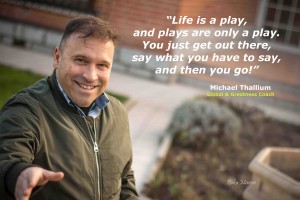
It’s a true story! It all happened to me many years ago. I was much younger, daring and probably very naive. I was that kind of person who thought he could really go places, and, it’s true, I went places, literally, because I travelled the world, I was even lucky enough to go on a world tour once, but anyway, that’s another story. So, as I was saying, it all goes back to the times when I used to work as a tourist entertainer on ships (one of the many jobs I’ve done in my life so far), on cruise ships. And I remember, we were somewhere, sailing around the Mediterranean Sea, in the south of Europe or the north of Africa, and one night, one of the passengers, he was an actor and a singer, he came to me and we started chatting, we were speaking for a while, you know, having that kind of interesting conversations, interesting conversations, you sometimes have with perfect strangers and he said to me: “You know, I like you, you seem to be quite a nice guy, and I’m going to tell you the best trick you can ever have to perform on a stage and be the best actor, and I’m going to give it away to you for free”, he said, the same way now I’m passing it on to you for free. So, he went on: “Because otherwise if you’d really like to know this trick, you should enrol on an incredibly expensive acting course in the United States. So, you’d better pay attention, boy!”, he said. “Do you want to know that trick?” “Yeah, sure,” I replied. By the way, do you, the viewer, you who are watching me now, listening to me, do you really want to know that trick?… So, he took me by the arm, tapped on my back, taking me to a separate place and said: “Imagine this is a stage, your stage. Here you go, listen carefully, pay attention, because this is the trick: you get on that stage, you say what you have to say… and then you go!” That’s it! Simple as that. “You get on the stage, you say what you have to say and then you go.”
This idea of “saying what you have to say and then you go” has been in the back of my mind for a number of years already. And although I might not have quite understood what it meant, the thing is that, over a period of years, I came to realise how powerful this idea was, because: what is life? I think life is a stage to run the scenes of your play. Since the very moment you’re born or even a bit earlier when you are still in your mum’s womb, you are on that stage. You have your audience from the very beginning: maybe your parents, your relatives, your parents‘ friends and acquaintances. And at the same time, they are also actors in your life, on your stage. This is a cast of actors you haven’t chosen when you were born, that’s true. They are given to you, either you like it or not, the same way the atrezzo, the props around you when you were born. You didn’t choose them. They are there on your stage.
Then, as you grow up, you may become the casting director of your life and you choose which actors, your relationships, you want in your play or not. You can choose them. But this power of choice is limited. Sometimes you may want someone to play a certain role in your play and that person doesn’t want to play that role, or otherwise: maybe someone wants you to play a role that you are not willing to take in and you may not even want to be part of their play at all. Isn’t that funny? I mean, this interactivity: you have your stage, you’re are the main actor of your life, but at the same time you share your own stage with other people who have their own stages and think you are part of their stage the same way you think they are part of yours. And this “stage sharing” makes your performance even more interesting… and complex, of course. And this is where “listening” really comes into play, because there will be no way you can perform, at least satisfactorily, if you are not listening, because listening is understanding. You don’t just listen with your ears, you listen with your whole body. And when you are listening, you are intereresting, and when you are interesting, people will pay attention to you. You, now, you are listening to me because, for some reason, you feel I’m listening to you, I’m taking you in, that’s why you are listening to me.
Some of those actors will stay in your life for a long period of time; some others will go, maybe even sooner than you expected or wanted. Some of them will have important roles, some others will have minor roles, they’ll be supporting actors. But there’s one actor who will stay your entire life with you, and that is “you”. So you’d better listen to yourself as well.
Next time you are called on the stage, remember this: go there, say and do what you want and need to say and do, and then you go. Try it! You can apply it, maybe today. If you run the scene well enough, your audience will get excited, you will have your curtain call and they may even clap and say bravo. But remember you can’t please everybody. There will be good performances, excellent performances, and bad performances you won’t be proud of, for sure. You won’t please everybody, even when you are at your best. Being the best listener you can be is all you can aim at, because this will make you the best actor you can ever be.
There’s something, though, I haven’t told you yet. One day we all will have our final curtain call: you will have your final curtain call, I’ll have my final curtain call. We don’t know exactly when. I don’t know when, but I know someday the final curtain will call upon me and this time I’ll have to leave… for good. That’s it! Time’s up! Game over! The end! That’ll be your final performance! By that, I mean, not knowing exactly when you’ll leave for good, I don’t mean you should live your life as if it were the last day in your life. Living like that didn’t work for me, it doesn’t work for me anyway. What really works for me is to come to realise I’m on my stage, I choose my cast of actors, my relationships -even when I’m somehow limited- and I run the scene the best I can because I’m listening.
Money -the atrezzo, the props, the technology in your play- money comes and goes. I’m not saying it’s not important, it is important, but it just comes and goes. Your body, my body, will change, it’ll decay as years pass by. That’s just wrapping.
You may be in your twenties and you think it’s impossible to get a job because the situation of the job market is not so good, or you may be in your forties or fifties and you’ve just lost your job, because you’ve been laid off, that job you’ve been doing for so many years, that now you feel miserable and think you are not good enough, because of that. No! YOU – ARE – GOOD. You are the actor of your life or the actress of your life if you’re a woman! I’m not saying it’s easy. It’s not. It’s hard actually: it can get really hard sometimes to be the best actor you can be and run a scene…
I believe what really makes you have a happy and healthy life is the cast of actors in your play. It’s not only the quantity but rather the quality of your relationships what wins.
I wish someday, you and me, you who are watching me now, you who are listening to me, I wish someday we have the chance to run a scene together, sharing our stage, and have a good time, even if it’s just momentarily, for a limited period of time, even more limited than the already limited time we’ll spend on this planet Earth. I wish after running that scene, we could take our bows together and say: thank you for being part of my play, even if it’s just been for a couple of minutes. And in my case, I also wish someday I come across that special loving woman who will stay, “just a little bit longer” as the song goes, so that we can run the very scene of our lives together before the final curtain calls upon us.
There is a play by a Spanish poet and playwright from the 17th century, Calderon de la Barca (1600-1681) -the play is called “Life is a dream”- and in this de la Barca’s play there is a very famous line that goes like this: “For life is a dream and dreams are only dreams”. The thing is that instead of that word, “dream”, I’d transform that line and rather say: “For life is a play and plays are no more and no less than a play”.
Well, I think I’ve already said and done what I wanted and needed to say and do. I’ve made my point several times by now. And if I told you this stoty well enough, I hope it can help you. Listen, say and do what you have to say and do, and then you go. So, I wish you luck with it!
On the following video I use a little game to speak about the numbers from 1 to 10 and about some nouns, verbs and prepositions in German. The basic vocabulary shown on this video is:
Substantives das Spiel, die Spiele: game, games (play, plays)
die Kiste, die Kisten: box, boxes
der Ball, die Bälle: ball, balls
die Ente, die Enten: duck, ducks
der Kegel, die Kegel: skittle, skittles
die Trommel, die Trommeln: drum, drums
das Kaninchen, die Kanningen: rabbit, rabbits
der Drachen, die Drachen: kite, kites
das Schiff, die Schiffe: ship, ships
das Auto, die Autos: car, cars
der Wagen, die Wagen: car, cars
das Kind, die Kinder: child, children
das Flugzeug, die Flugzeuge: airplane, airplanes
Verbs
nehmen: take
werfen: throw
greifen: catch, grab
jonglieren: juggle
Prepositions
auf: on, upon
in: in
vor: in front of
hinter: behind
On the following video I speak about the colours in German. The basic vocabulary shown on this video is:
Nouns
die Farbe, die Farben (feminine): colour, colours
der Bleistift, die Bleistifte (masculine): pencil, pencils
der Farbbleistift, die Farbbleistifte: colouring pencil, colouring pencils
das Telefon, die Telefone (neutral): telephone, telephones
Adjectives rot: red
grün: green
schwarz: black
weiss: white
gelb: yellow
blau: blue
orange: orange
braun: brown
grau: grey
pink: pink
violett: purple
Nominative structure:
Der Bleistift ist schwarz / Das ist ein schwarzer Bleistift (masculine)
Das Telefon ist schwarz / Das ist ein schwarzes Telefon (neutral)
Accusative structure: Ich habe einen schwarzen Bleistift (masculine) / Ich habe ein schwarzes Telefon (neutral)

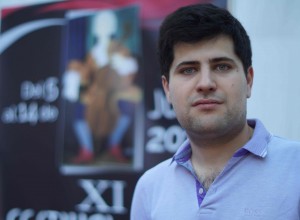 I first met Mikhail Pochekin on a cold Sunday morning of snow in Madrid. It was back in February 2018 and I had to cover for the Spanish music magazine Scherzo —actually my first collaboration— Pochekin’s recital accompanied by the great pianist Yury Favorin —his Prokofiev’s interpretations have no equal— at Fundación Juan March. When the recital was over, I made for the artist’s dressing room and Mikhail, with those cat eyes of his, as profound as profound his music performances are, talked about his brother Ivan with admiration. They both had just recorded a CD and he gave me a copy as a present to listen to. And that was what I did: listening to it attentively and with delight. After some months touring around Russia and Europe, destiny made us meet again in Becerril de la Sierra, a little town near Madrid, Spain, where Pochekin’s parents have been living for some years already. Mikhail invited me to see his dad’s workshop. Yuri Pochekin is an internationally renowned luthier who has just turned 70 this year. Most of the violins with which the Pochekin brothers play at their recitals have come out of this little workshop. Mikhail Pochekin is a violinist of exciting musicality, impressive technique and deep musical insight; intelligent —he speaks Russian, Spanish, English and German—, friendly and enthusiastic. When it comes down to music, things are clear to him. One of his aims is to bring classical music closer to people of all walks of life.
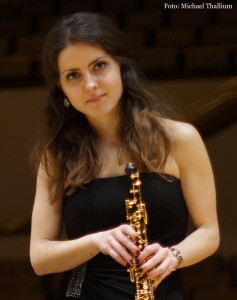 Let’s be clear!
  The title on that cover caught my attention. It was a CD box. A white and black picture of an old man wearing glasses and slightly smiling was featured; his chin upon his right hand holding a pencil. The text read: