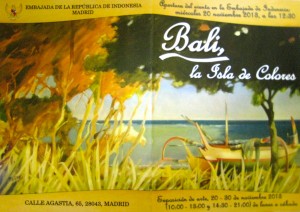
A message of Adiyatwidi Adiwoso Asmady, Ambassador of Indonesia in Madrid, in order to promote cultural exchange between the West and the East, between Bali and Madrid, between Indonesia and Spain, between Asia and Europe. The exhibition “Bali, the Island of Colours” will be held at the Embassy of the Republic of Indonesia (Madrid, Calle de Agastia, 65) from 20th to 30th November 2013. Works by the German painter Gorns Bruchmann.
Recently, as a result of an experiment I am doing to develop my empathic listening –among other things, it consists in studying each an every one of Beethoven’s nine symphonies–, and after a month dedicated to Beethoven’s 1st Symphony, I started to think about Sergei Prokofiev’s 1st Symphony, for sure the most performed of all of his seven symphonies. So far, that was the only symphony by Prokofiev that I knew, because I had listened to it when I was a child. I used to have a vinyl of Leonard Bernstein’s performance with the New York Philharmonic Orchestra. It was an exquisite recording where, apart from Prokofiev’s 1st, you could also enjoy Georges Bizet’s 1st Symphony in C major with a memorable oboe solo in the Adagio by Harold Gomberg.
As I was saying, Beethoven’s Symphony no. 1, very classical in style, led me to Prokofiev’s 1st Symphony, known as “The Classical”. Since I no longer have a record player, I decided to buy another version of this master piece. I opted for Yuri Temirkanov’s recording with the St. Petersburg Philharmonic Orchestra. Why Temirkanov? Well, some time ago, Kavichandran Alexander, president of Water Lily Acoustics, gave me a CD as a present. It was a fabulous performance of Gustav Mahler’s Symphony no. 5 by Temirkanov and the St. Petersburg Philharmonic Orchestra. Then when I came across Temirkanov’s version of Symphony no. 1 by Prokofiev, it aroused my curiosity and I decided to buy it. And I do not regret it!
One thing leads to another. Listening to Prokofiev’s 1st Symphony again made me remember a wonderful documentary by Peter Rosen on the Armenian composer Aram Khachaturian. Dmitri Shostakovich and Sergei Prokofiev appeared in the documentary as well. Three great and outstanding composers who were accused of being “anti-democratic” and “anti-people” by Stalin on February 10th 1948 (Zhdanov Decree). Stalin’s politburo condemned the “formalist music” written by Myaskovsky, Shostakovich, Khachaturian and Prokofiev among others. It was considered that “formalism” was out of the “socialist realism” and Prokofiev’s melodies were considered too “cacophonic”. As a result of the “Zhdanov Decree”, Prokofiev’s first wife, the Spanish Carolina Codina –known as Lina Prokofiev and also as Lina Llubera, her artistic name–, was arrested on false charges and accused of espionage and sentenced to twenty years in a Siberian force labour camp in 1948. Prokofiev divorced her and married Mira Mendelssohn (they had been having an affair since 1939). Carolina spent eight years in Siberia, until 1956 when millions of Stalin’s innocent victims were granted a general amnesty. Prokofiev had died three years earlier, in 1953, at age 61.
Wow! What a story! When you start pulling the thread, you never know where you will end up… But that was not the goal of this article. I started speaking about symphonies, didn’t I? Well, to make the story short, I ended up listening to the seven symphonies by Prokofiev and I would like to share with you the collection of my choice:
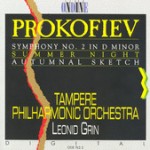
Symphony no. 2 in D minor, opus 40. Tampere Philharmonic Orchestra conducted by Leonid Grin. Written between 1924 and 1925 during the Parisian years of Prokofiev, this symphony is, by far, the least performed and recorded of all of his symphonies. Radically different from his 1st Symphony, “The Classical”, it was inspired by the structure of Beethoven’s last sonata: Allegro and Theme with variations. Pure rock ‘n’ roll!
Symphony no. 3 in C minor, opus 44. Moscow Philharmonic State Symphony Orchestra conducted by Dmitri Kitayenko. Written in 1928, this symphony is based on Prokofiev’s opera The Fiery Angel that he had finished in 1927. This opera was never premiered during Prokofiev’s life time.
Symphony no. 4 en C major opus 47/112. Orchestra of Philadelphia conducted by Vladimir Jurowski. Based on the ballet The Prodigal Son, this symphony is so good that Prokofiev wrote it twice: one time in 1929 and another time, in 1947. Hence the two opus numbers 47 and 112. The two version are different from the stylistic point of view. Jurowski’s performance corresponds to opus 112.
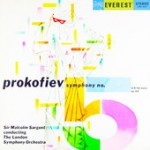
Symphony no. 5 in b flat major, opus 100. London Symphony Orchestra conducted by Malcolm Sargent. It was written in the summer of 1944, that is, fifteen years after the previous symphonies. Prokofiev composed this work in a haven he was sent along with Khachaturian and Shostakovich by the Soviet Authorities. They wanted to keep the artists away from the war front line. For Prokofiev this symphony was a hymn to the free and happy man, to his mighty power and his pure and noble spirit. To my taste this Malcolm Sargent’s version on Everest Records is exquisite!
Symphony no. 6 in E flat minor, opus 111. Bergen Philharmonic Orchestra conducted by Andrew Litton. Composed in 1947, this symphony was condemned in 1948 (Zhdanov Decree) by the Soviet government despite good critics and warm welcome. It is an elegy to the tragical consequences of World War II, a song to the pain of war.
Symphony no. 7 in C sharp minor, opus 131. London Symphony Orchestra conducted by André Previn. Prokofiev finished writing this symphony in 1952, a year before his death. This symphony, although somehow melancholic, is more optimistic than the previous one. Due to the unfortunate events of 1948, Prokofiev was living in poverty and he decided to add a little optimistic coda at the end of the symphony in order to win the Stalin Prize of 100,000 rubles. However, before he died, Prokofiev said that the original ending without the coda was preferred. Apparently, he asked chelist and conductor Mstislav Rostropovich to eliminate the coda. André Previn’s version includes that final coda.
It is my intention to contribute with this article to the dissemination of the unknown symphonic work of the this extraordinary symphony composer who is Sergei Prokofiev. I encourage you to start with Symphony no. 1 and taste the sound world of one of the greatest composers of the 20th century.
What about you? What would be the collection of your choice?
“I’m an argonaut of the noosphere and I use music
as a vessel for exploration.” – Michael Thallium
A couple of days ago, I came across with Atrévete a saber, the Spanish translation of Abbi il coraggio di conoscere, the book that Rita Levy-Montalcini wrote at the age of 97. I think there is no English translation yet, but the title would go something like Dare to Know! Apparently Rita had been adding some corrections to her book until a few months before her passing in December 2012 at age 103. The title caught my eye and I decided to download the e-book. A couple of years ago, I read In Praise of Imperfection, a fantastic book in which Rita Levy-Montalcini tells, with all due humility, the story of how she discovered the NGF (Nerve Growth Factor) and she uses her story as a proof of human imperfection. I was inspired by her praise of imperfection and now I am inspired by her exhortation: Dare to know! Reading her book I learnt about a new concept for me:”argonaut of the noosphere”. I love this metaphor and it describes perfectly my will to know everything related to the mind and the brain, ultimately to the human being.
For me music has a key role in the learning of any discipline: from languages, mathematics or leadership up to history or physics. I do not refer to music in terms of an instrumentalist or professional musician, but in terms of someone who understands music as the integrator of different knowledge realms and different ways of feeling. Then, I dare to say I consider myself an argonaut of the noosphere and I use music as a vessel for exploration.
The symphony of life demands a great deal of preparation from the ‘maestro’ who is conducting it, and the success in balancing each and every voice in life is the result of their mastery to combine knowledge and emotions. The thing is that not everybody is willing to be the ‘maestro’ of their respective symphonies. You need time, dedication and, above all, to be aware that the way is the goal.
“Within all of us, as deep as the oceans and as individual as a fingerprint, lies an endless flow of original music.” – Dave Frank
For those of you who still don’t know him, let me introduce you to Dave Frank today. Dave, besides being an excellent musician and music educator, he is a great person, generous, humble and with the funniest sense of humor. I feel lucky to collaborate with him from the distance. Let this post be the starting point for long, fruitful and cheerful collaboration between New York (Dave Frank) and Madrid (me, Michael Thallium). Here’s Dave:
What apart from music is the passion of your life? Seeking God through yoga and meditation.
Who was your most influential teacher, and why? In music –Lennie Tristano, as he taught me how to play jazz and became the role model for my life. In life, Paramahansa Yogananada, his teachings and practices have transformed my life experience. Yogi Bhajan, master of kundalini yoga, as well.
How do you relax? I tickle my wife.
What is your favourite book, and why?
Autobiography of a Yogi, by Yogananada, because it was able to able to answer the really difficult questions about life.
You can have dinner tonight with a famous person—who would it be and why? Colonel Sanders, founder of Kentucky Fried Chicken. No reason.
My path in life is about practice. When you practice what you truly love with feeling, the universe opens up to you. The highest benefit of practice, besides the improvement in whatever you are practicing –is that your mind becomes quieter and absorbed in what you are doing. This state of mental quietness and absorption is the doorway to the higher aspects of life. Practice becomes a personal haven for you and you alone, in which to dwell in what you love and forget about the rest! Setting a really high life-goal for yourself (even something that may seem unattainable), and then charting a course through practice to make continual progress toward your dream – is giving yourself the gift of a happy, interesting, and meaningful life.
For me, the most important things to do to achieve life-goals are these:
Find a GREAT teacher, a master in what you seek to learn, and take regular lessons with your chosen teacher.
Decide on what you want to achieve, and with the help of your teacher, set forth a clear, step-by step practice routine that will take you where you want to go.
Follow through on your plan for a long time with enjoyment and regularity
Rinse and repeat for the rest of your life. You’ll be a HAPPY person.
You can also find Dave on Facebook: https://www.facebook.com/dfrankjazz. Check the following video and enjoy an example of how to create an improvisation from a walking bassline:
Professor Thomas Südhof has been awarded the 2013 Nobel Prize of Medicine and Physiology together with Professors Jim Rothman and Randi Shekman. Professor Südhof once said that he owed his incredible powers of analysis and concentration to studying a musical instrument: the Bassoon.
What apart from your family is the passion of your life?
I always try to understand everything I encounter—not only in science, but also historical and political events and music and movies—get to grips with the content, meaning, and process. This is immense fun, as strange as that may sound.
Who was your most influential teacher, and why?
My bassoon teacher, Herbert Tauscher, who taught me that the only way to do something right is to practice and listen and practice and listen, hours, and hours, and hours.
How do you relax?
Drink wine and talk to the people I love.
What is your favourite book, and why?
Johann Wolfgang von Goethe’s Faust, because it is a microcosm of the world and Goethe’s beautiful language expresses all of our potential and contradictions.
You can have dinner tonight with a famous person—who would it be?
Wolfgang Amadeus Mozart, so that I could try and find out if his creativity was conscious or inherent.
But there’s more! Did you know that Professor Südhof was somewhere in the middle of Spain when he was told he had been awarded the Nobel Prize? You’ll love this interview!
This is a monthly column on uncovering our greatness, co-authored by Dr Amit Nagpal from India (who talks about a Westerner) and Michael Thallium from Spain (who talks about an Easterner). We aim to share the success stories of great human beings and wish to inspire the readers to uncover their greatness too.
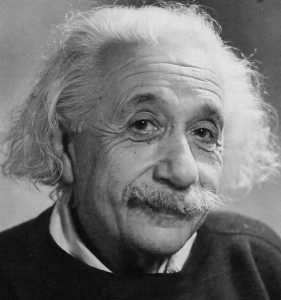
I woke up murmuring, “E= mc2” and I realized I had a chat with Einstein in my dream. “What the hell?” I thought in my partial sleep, “Are there not better people to dream about in life?” Soon I woke up and realized (thanks to my friend Jennifer Sertl), Einstein had become my hero in 2011.
I once posted on a humourous note, “Einstein’s wife once asked him, ‘How much do you love me?’ He replied, ‘You can calculate my loving energy at different points of time using E= mc2. ‘“ It might have been true.
Instead of introducing the genius, I would rather say, “Here comes Albert Einstein, who needs no introduction.” But I will still remind you that he was a German-born theoretical physicist credited for developing the general theory of relativity, one of the two pillars of modern physics. The story goes, “His father once showed him a pocket compass; Einstein wondered that there must be something making the needle move, despite the “empty space”. No wonder he began to build models and mechanical devices for fun and showcasing his talent for mathematics”
Albert Einstein is known as one of the greatest geniuses of all time. But there is a part of his personality unknown to most of the people. He was a very balanced person in so many ways. He believed firmly in both matter and energy, science and religion, intuitive and rational mind (soul and mind in eastern parlance) and saw a genius in everyone. No wonder he believed that science without religion is lame and religion without science is blind. He saw the hidden potential everyone has and pointed out, “Everyone is a genius. But if you judge a fish by its ability to climb a tree, it will live its whole life believing that it is stupid.”
In spite of doing some of the most complicated research ever done, he was a believer in the power of simplicity. No wonder he said, “If you can’t explain it simply, you don’t understand it well enough.” He also emphasized that any intelligent fool can make things bigger or more complex and it took touch of a genius and courage to move in the opposite direction.
People don’t know the funny side of Einstein. He used to believe that creativity is nothing but intelligence having fun. He said, “When a man sits with a pretty girl for an hour, it seems like a minute. But let him sit on a hot stove for a minute and it is longer than any hour. That’s relativity.” He remarked with a humourous touch once, “The difference between genius and stupidity is that genius has its limits.”
Here is a better one coming, “Any man who can drive safely while kissing a pretty girl, is simply not giving the kiss the attention it deserves.” He once joked, “If a cluttered desk is a sign of a cluttered mind, of what, then, is, an empty desk a sign?” In fact that is more dangerous, an empty desk and an empty mind (By the way, I am overjoyed to hear this because my desk is cluttered too, and that means I don’t have an empty mind). He said it with a pinch of humour that gravitation is not responsible for people falling in love. (And very few rise, for that matter. Don’t curse me ladies, this is on a humourous note).
He also had a strong spiritual side. He held that a happy man is too satisfied with the present to dwell too much on the future. He said, “I live in that solitude which is painful in youth but delicious in the years of maturity.” No wonder he refused life support systems to carry on and died peacefully at the age of 76. He also knew the importance of having a life purpose (deep passion) and suggested that if one wants to have a happy life; one should tie it to a goal and not to people and objects.
He hinted at raising our level of consciousness and wisdom and understood that we cannot solve our problems with the same thinking we used, when we created them. After all doing the same thing again and again and expecting different results can only be insanity. In spite of being such an acclaimed scientist, he humbly accepted the mysterious side of the Universe. He says, “Human beings, vegetables or cosmic dust-we all dance to a mysterious tune intoned in the distance by an invisible piper.” He spoke with everyone in the same way, be it the garbage man or the president of university.
He understood the powers of conscious and subconscious mind and pointed out a very sad truth of our times, “The intuitive mind is a sacred gift and the rational mind is a faithful servant. We have created a society that honours the servant and has forgotten the gift.” In my view, this is the reason behind all the ills in human society.
Einstein was really fond of creativity and imagination. He believed that imagination is more important than knowledge. He says, “Logic will get you from A to B. Imagination will take you everywhere. “ Sometimes Einstein could be a poet too. He says, “A question sometimes drives me hazy, Am I or are the others crazy?” (You were not crazy dear Einstein, we are).
At times, he was brutally honest too. No wonder he said, “Two things are infinite, Universe and human stupidity…and I am not so sure about the Universe.” And probably he saw the future and commented, “I fear the day when technology will surpass our human interaction. The world will have a generation of idiots.”
I pray that we develop wisdom before that and such a day never arrives.
It has been a little bit more than half a year since our last post. Personally, I decided to take a break and a distance from the social media for a while and use my time over the summer, here in Europe, in order to listen to myself, to find myself, to become my own “instrument” and explore my “performance possibilities” (work still in progress, I must say). I took the chance to take a short trip to Edinburgh in Scottland to visit some old friends. Then I spent some time with two very good friends of mine in Cantabria, in the north of Spain, and in Extremadura, in the southwest.
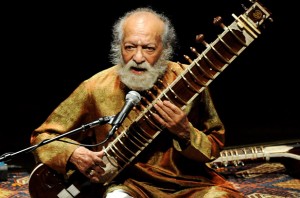
But now we, Amit and I, are back with this series of articles on great people. And I decided to speak about Ravi Shankar, who died in december 2012. We usually speak about people who are alive. So, take this as an exception… but I think it is worth it, because Ravi Shankar’s exeptional work lives on in his two daughters: Nora Jones and Anoushka Shankar.
For those of you who never heard of Ravi Shankar, let me give you a little bit of background. Shankar was a musician, composer and virtuoso of the sitar, although in his childhood he was also a dancer, touring internationally at age 13 with his brother, the choreographer Uday Shankar. He gave up dancing and took on various Indian instruments becoming a virtuoso of sitar under guru Allauddin Khan. I don’t need to tell you how hard, demanding and strict the training as an Indian classical musician is!! No wonder Shankar is an example of endurance for me. His international career expands over more than 60 years… Not bad!! And this is the reason why I decided to speak about him. Not only because of his so many years touring around the world, but also because he exported Indian classical music and collaborated with different artists and musicians from all over the world. He highly contributed to unite East and Western cultures.
If you want to learn more about Ravi Shankar’s life, I recommend you to read the book his daughter Anoushka Shankar wrote back in 2002 “Bapi: Love Of My Life”. She dedicated her book to the best sitar player in the world. In Anoushka’s words: “Let me be shamelessly adoring for a moment: I think Bapi is the most wonderful man in the world. He makes the most beautiful music I have ever heard. His integrity and connection to his instrument is unparalleled by anything I have seen. He has to be the funniest man on earth who isn’t a professional comedian. As a father he is more loving and giving than I ever dreamed was possible. And I doubt I’ll ever be lucky enough to find a man for myself who is as romantic and passionate as my father is with my mother. To be honest, I’m not sure I’ll ever be really happy with any man in my life because I would want him to measure up to my dad!”
All I can say is that you would be amazed to find out about Ravi Shankar’s extraordinary life and the role that forgiveness played in it. Let me finish with a letter Ravi wrote to her daughter Anoushka:
“My ‘Hey-Smoochka’. I miss you! I want to hug you and cuddle you and give you all the love I feel for you—which I was stupid enough to not give to you for various reasons (we must talk about all that, please!) when you were very young! It is never too late—and you are such a wise young lady! Our roles as Guru, father and a friend—and disciple, daughter and friend is not so easy—I know! But enough is enough—and we have wasted too much time and must make up for all the time lost! You will see how much it will improve my health and gloom and how much happier we all would be with you, me and mum as “S P G” chord, we will F(oops!) conquer the world!! I send my hugs and kisses and prayers for all in the world for you. Love Bapi”
Well, now you know! It is never late to mend the broken pieces and start again. So, just become a pebble, through yourself into the pond of life and watch the ripples!
Here you are my summer recapitulation. I would like to share with you what I have been doing over the last months of a summer which has just finished a couple of days ago, here in Spain. I would also like to sketch out what I call my “autumnal projection”, that is, what I will be doing over the coming months.
I started the summer by taking a distance from the Internet and the social media, particularly from Facebook and Twitter. I needed time for myself, for some reflection, for some travelling. And I used music to do so. Over the last three months I have listened to lots of music. Those of you who know me, you will know of my passion for coaching and music. Coaching is a process by which a person can achieve goals. In this process, we use language (the conversations between the coach and the coachees), and music is also a powerful language we can take advantage of in order to practice our empathic listening, our analyzing ability and, essentially, our ability to explore and experiment. In my desire to systematically integrate music in the coaching and transleadership world, I decided to walk the talk myself. So, here you are some of the works I have been experimenting with:
Guillaume de Machaut Misa de Nostre Dame, Le vray remède d’amour and Le Jugement du Roi de Navarre.
Madrigals by Josquin Desprez, Thomas Morley, Thomas Weelkes and Carlo Gesualdo.
Claudio Monteverdi
The operas L’Orfeo and Il ritorno d’Ulisse in patria.
Henry Purcell
The opera Dido y Aeneas
Georg Philip Telemann Tafelmusik, Sinfonia Spirituosa, string concertos and flute quartets, Ino Cantata.
Johann Sebastian Bach
The two books of The Well Tempered Clavier and The Coffee Cantata.
Johann Christian Bach Sinfonias op. 1, Keyboard Concertos op. 7, Trios op. 2 & op. 15, the operas Amadis de Gaule and La Clemenza di Scipione.
Ludwig van Beethoven
Complete 32 sonatas for piano (I listened around for times to each sonata… yes, I know, I know, it’s a lot of listening hours!), and the nine symphonies.
Carl Maria von Weber
The opera Der Freischütz and the piano sonatas nos. 2 & 3.
Franz Schubert
The eight symphonies.
Robert Schumann Cello Concerto in A minor, Piano Concerto in A minor and the four symphonies.
Camille Saint-Saëns Symphony no. 3 and the five piano concertos.
Gustav Mahler Symphony no. 3.
Charles Ives Quartets nos. 1 & 2.
Arnold Schoenberg Verklärte Nacht and Pierrot Lunaire.
Béla Bartók Viola Concerto, Piano Concerto no. 2, the opera Duke Bluebeard’s Castle.
Dmitri Shostakovich
The opera Lady Macbeth von Mzensk.
Sergei Prokoviev
The opera L’Amour des Trois Oranges.
Paul Hindemith
The operas Mathis der Maler andMörder, Hoffnung der Frauen.
Alfred Schnittke Symphony no. 4, Requiem and el Piano Quintet.
Alexander Shchetynsky
The choral works Know Yourself, Light to Lighten.
From the above mentioned works, I focused more on the complete sonatas by Beethoven and Mahler’s 3rd Symphony.
But I not only filled my hours with music. I also took the chance to make a trip to Edinburgh, in Scotland, and visit some old friends. Then I travelled to Cantabria, in the north of Spain, with two beloved friends from childhood. I can tell you it is an amazing experience to listen to Mahler’s 3rd Symphony in the nature and surrounded by breathtaking mountains. From the north of Spain I came down to the southwest. I spent some days in the province of Caceres visiting different places such as the Monastery of Yuste, the place where the Holy Roman Emperor Charles 5th retired and died. I particularly liked a small village called Garganta la Olla, which I recommend you to visit if you ever come to Spain and visit that region. Then I decided it was time for me to spend some time with my dad alone -something we had never done before- and we both decided to “explore” different places in the Castillian region, places such as Toro, Villafafila, Zamora, Fermoselle, Ledesma and Salamanca.
And what is that “autumnal projection” I mentioned at the beginning of this post? Well, despite of all those listening hours I spent, the fact is that I still consider they were not enough in order to achieve my goal? And what is my goal? To practice the empathic listening, the exploration, the analysis and the connection… So, I decided to dedicate the coming months to listen to and read -that’s why I bought the scores- The Well Tempered Clavier by Bach, one Prelude & Fugue a day (there are a total of 48 preludes and fugues, so I hope I can finish with it in two months, that is, by the end of November); equally, I will dedicate a week to each sonata by Beethoven (there are 32 of them, so it will take me around eight months to complete the task… and that means I will be finishing by the time Spring arrives next year).
Some people need drugs in order to reach an elevated state of relaxation or concentration or meditation. I can tell you that if you immerse yourself into Beethoven’s last sonatas (nos. 30, 31 & 32), you will reach the highest state of meditation and much healthier than what you can expect from the use of any drugs.
Now that the new fiscal year is about to start, I pick up my Internet collaborations again. It is also my intention to finish my PhD thesis on coaching, communication and globalisation -something that I have been putting off for years- and to keep on developing my professional activity. So, get on with it! I leave you here with my last musical discovery: a Ukrainian composer whose name is Alexander Shchetynsky and his symphony for mixed choir entitled Know Yourself:
Today is a special day for Americans: 4th July. Half a year ago, when I spent my Christmas holidays at the “House of The Three Flowers” -Jeanie Flowers (mum), Rachel Flowers (daughter) and Vaughan Flowers (son)- in California, playing around with music, we recorded a video with a very special version of The Star Spangled Banner. I think it is worth sharing it here with you today…
It is Friday and for many people it is the last working day before the weekend. Today I would like to leave a quote and some music with you: Spanish writer and philosopher Balthasar Gracián, who will talk about not to complain and Russian composer Dmitri Shostakovich, who was not allowed to complain for many years in his lifetime and he used music as a vehicle of self-expression and creativity. Shostakovich wrote his first symphony when he was 19. It was his assignment for his graduation at the conservatory of Petrograd (Saint Petersburg, presently).
Today’s maxim: stop learning, make the transition to thinking and creating
“Never complain. To complain always brings discredit. Better be a model of self-reliance opposed to the passion of others than an object of their compassion. For it opens the way for the hearer to what we are complaining of, and to disclose one insult forms an excuse for another. By complaining of past offences we give occasion for future ones, and in seeking aid or counsel we only obtain indifference or contempt. It is much more politic to praise one man’s favours, so that others may feel obliged to follow suit. To recount the favours we owe the absent is to demand similar ones from the present, and thus we sell our credit with the one to the other. The shrewd will therefore never publish to the world his failures or his defects, but only those marks of consideration which serve to keep friendship alive and enmity silent.” – Balthasar Gracian (1601-1658), The Art of Worldly Wisdom, 1947
Symphony No. 1 in F minor, Op. 10 (1923-25)
I. Allegretto – Allegro non troppo
II. Allegro (Scherzo)
III. Lento
IV. Allegro molto

 Recently, as a result of an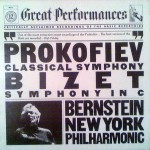

 Symphony no. 2 in D minor, opus 40. Tampere Philharmonic Orchestra conducted by Leonid Grin. Written between 1924 and 1925 during the Parisian years of Prokofiev, this symphony is, by far, the least performed and recorded of all of his symphonies. Radically different from his 1st Symphony, “The Classical”, it was inspired by the structure of Beethoven’s last sonata: Allegro and Theme with variations. Pure rock ‘n’ roll!
 Symphony no. 3 in C minor, opus 44. Moscow Philharmonic State Symphony Orchestra conducted by Dmitri Kitayenko. Written in 1928, this symphony is based on Prokofiev’s opera The Fiery Angel that he had finished in 1927. This opera was never premiered during Prokofiev’s life time.
 Symphony no. 4 en C major opus 47/112. Orchestra of Philadelphia conducted by Vladimir Jurowski. Based on the ballet The Prodigal Son, this symphony is so good that Prokofiev wrote it twice: one time in 1929 and another time, in 1947. Hence the two opus numbers 47 and 112. The two version are different from the stylistic point of view. Jurowski’s performance corresponds to opus 112.
 Symphony no. 5 in b flat major, opus 100. London Symphony Orchestra conducted by Malcolm Sargent. It was written in the summer of 1944, that is, fifteen years after the previous symphonies. Prokofiev composed this work in a haven he was sent along with Khachaturian and Shostakovich by the Soviet Authorities. They wanted to keep the artists away from the war front line. For Prokofiev this symphony was a hymn to the free and happy man, to his mighty power and his pure and noble spirit. To my taste this Malcolm Sargent’s version on Everest Records is exquisite!
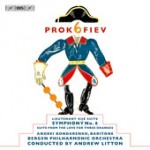 Symphony no. 6 in E flat minor, opus 111. Bergen Philharmonic Orchestra conducted by Andrew Litton. Composed in 1947, this symphony was condemned in 1948 (Zhdanov Decree) by the Soviet government despite good critics and warm welcome. It is an elegy to the tragical consequences of World War II, a song to the pain of war.
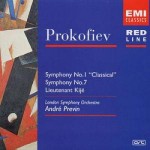 Symphony no. 7 in C sharp minor, opus 131. London Symphony Orchestra conducted by André Previn. Prokofiev finished writing this symphony in 1952, a year before his death. This symphony, although somehow melancholic, is more optimistic than the previous one. Due to the unfortunate events of 1948, Prokofiev was living in poverty and he decided to add a little optimistic coda at the end of the symphony in order to win the Stalin Prize of 100,000 rubles. However, before he died, Prokofiev said that the original ending without the coda was preferred. Apparently, he asked chelist and conductor Mstislav Rostropovich to eliminate the coda. André Previn’s version includes that final coda.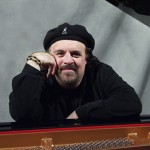

 I woke up murmuring, “E= mc2” and I realized I had a chat with Einstein in my dream. “What the hell?” I thought in my partial sleep, “Are there not better people to dream about in life?” Soon I woke up and realized (thanks to my friend
  It has been a little bit more than half a year since our last post. Personally, I decided to take a break and a distance from the social media for a while and use my time over the summer, here in Europe, in order to listen to myself, to find myself, to become my own “instrument” and explore my “performance possibilities” (work still in progress, I must say). I took the chance to take a short trip to Edinburgh in Scottland to visit some old friends. Then I spent some time with two very good friends of mine in Cantabria, in the north of Spain, and in Extremadura, in the southwest.
 Here you are my summer recapitulation. I would like to share with you what I have been doing over the last months of a summer which has just finished a couple of days ago, here in Spain. I would also like to sketch out what I call my “autumnal projection”, that is, what I will be doing over the coming months.
 But I not only filled my hours with music. I also took the chance to make a trip to Edinburgh, in Scotland, and visit some old friends. Then I travelled to Cantabria, in the north of Spain, with two beloved friends from childhood. I can tell you it is an amazing experience to listen to Mahler’s 3rd Symphony in the nature and surrounded by breathtaking mountains. From the north of Spain I came down to the southwest. I spent some days in the province of Caceres visiting different places such as the Monastery of Yuste, the place where the Holy Roman Emperor Charles 5th retired and died. I particularly liked a small village called Garganta la Olla, which I recommend you to visit if you ever come to Spain and visit that region. Then I decided it was time for me to spend some time with my dad alone -something we had never done before- and we both decided to “explore” different places in the Castillian region, places such as Toro, Villafafila, Zamora, Fermoselle, Ledesma and Salamanca.