Entradas recientes / Recent Entries
|
 Michael Thallium in Nordaustlandet, 2014
I have been giving it a thought for a while to what article to write after almost six months of inactivity on my blog. Quite a few things have happened ever since. After my short stay in Latvia in order to get some navigational certificates, an occassion that I used to meet the Latvian composer Rihards Dubra, I embarked on a four month project, from the end of May until the end of September 2014, on board an expedition ship around the Arctic. That experience helped me to discover a region of the world that I did not know. Four months and 12 expeditions, mainly around Svalbard, although we also sailed around Northeast Greenland and Iceland in September. It also helped me to understand that you not always can succeed in all the projects you start and you have to be ready to face and accept adverse and not wanted results. And, for sure, from all those four months I spent there, there is something I am really happy about: the people I share my time with and talked to.
Back in Spain, I spent a couple of weeks adapting myself to a very different reality. I had trouble getting used to the noise, both sound noise and -even more harmful- media noise. Actually, I think I did not quite get used to it yet.
Thanks to Marian, from Ars Antiqua, I happened to know about a music shop —CDs, books & events— right in the heart of Madrid. It is called La Quinta de Mahler (LQM), a place where they organise lots of activities and it has become a kind of stomping ground for me. By the way, I recommend you to pay them a visit if you are in Madrid: Juan Lucas and Jose will serve you really, really well.
In these two months since I came back to Spain, I also had the opportunity to pay a visit in Cantabria to the composer and friend of mine Ananda Sukarlan, who was finishing his opera “Clara” to be premiered in Jakarta on 14th December 2014.
Sometimes, I find it difficult to explain to people what I do, because most people think that music is only to be listened to as background music, to dance or to entertain. I use music to do other things that apparently have nothing to do with it: teaching languages, leadership, communication, team work… Listening to music with all your senses enhances your ability to listen to people empathically. I will tell you about the result of the experiment I started over a year ago. I talked about it on this blog: On my listenings (part 1) .
The objective is eternal and unshakeable; the subjective changes with the circumstances and processes of internal growth. May your circumstances and processes influence your reality in the greatest positive way!
Michael Thallium
Global & Greatness Coach
Book your coaching here
You can also find me and connect with me on:
Facebook Michael Thallium and Twitter Michael Thallium
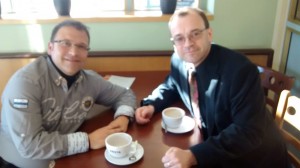 Rihards Dubra & Michael Thallium. Riga, May 2014. I was recently in Latvia and I had the chance to meet the Latvian composer Rihards Dubra. From the very first moment I got in touch with him via email, I immediately knew that he was a very approachable person, very simple. And when we actually met, one of my first impressions was that Rihards Dubra is a very humane composer. Actually, when I said to him that I was surprised to find such an affable composer —unfortunately, in the world of concert music, you often find plenty of arrogant people, full of themselves—, he replied: “You know, I’ve grown up in the countryside, among cows.” Then he told me a funny anecdote. It happened to him when he went to the United States for the premiere of one of his works. Before the concert started, one of those typical American “cowboys” with hat and all, sat down next to him and greeted him. The cowboy started to read the program. Several works from different composers would be played, one of them, Dubra’s. Then the American cowboy started to make comments about the different composers and works until he realised that there was one composer he had never heard of. Then he asked Dubra: ”You know, this guy, this ‘Richard’ Dubra, is he alive?” Rihards smiled and answered: “I’m afraid so, because it’s me”. Surprised and maybe a little bit embarrassed, the cowboy remained silent for the rest of the concert. At the end of the concert, he gave Rihards a little nudge and, as if he would be revealing a little secret, he said: “You know, your work, I liked it the most!”.
By the time I met Rihards Dubra in Riga (May 2014), he told me he was just about to finish his second symphony and very soon he could fulfill one of his dreams: to write his first opera. You can see and listen to him on the next video. With this interview, I hope to contribute to disseminate Dubra’s work and Latvian music in general.
Meeting Rihards Dubra – Riga2014 Capital of Culture from Michael Thallium on Vimeo.
Michael Thallium
Global & Greatness Coach
Book your coaching here
You can also find me and connect with me on:
Facebook Michael Thallium and Twitter Michael Thallium
(Article originally published on Huffingtonpost.com)
The world breaks everyone and afterward many are strong in the broken places ~ Ernest Hemingway
 Jennifer Sertl, Business Strategist & Executive Coach I am a reconciliation of spirits. My father was a surgeon and my mother a painter and musician who played 12 instruments. My parents divorced when I was 10, which was a good thing. The separation helped relieve the constant tension between rational intellect and creative expression. At one point, you might think intellect would win, but in the end raw expression had more endurance. I say this as my mother has a dragon to slay called mental illness.
When my mother was younger, she didn’t always take her prescribed medication. As a result, she attempted suicide three times that I know of. I was very angry about her attempts. In fact, I can remember that at one point I even wished she would succeed, not because I was a cruel child, but because it was so hard to know whether, at any given time, she was stable or present or safe or alive. The anxiety of “not knowing” and constantly having to worry were very painful. Fearful as I was about my mother’s health, it turns out that my father, who had long been as stable as a rock and I might add as emotionally impenetrable, was killed in a car accident when he was just 44 years old. I was 24 at the time.
There’s a saying in Wyoming: “When the wind stops, the cows fall down.” I had no idea how much the force of my father’s presence was like the wind, or how much I was buoyed by my resistance to him. His death came as a complete shock. I had always thought my mother was the fragile one. I had no idea life would teach me otherwise.
Why am I writing this now? I am turning 44 this month and am facing the question that many people have already confronted “Will my life transcend my parents’ fate?” The occasion makes me reflect on what I learned from my childhood. Furthermore, unlike cancer survivors wearing a band to signify their strength, resilience, community and triumph, there is no such zeitgeist for those who struggling with mental illness. So with my birthday and Mother’s Day fast approaching, I felt it would be both cathartic and helpful to share how much I learned from my mother’s illness.
Here is what her dragon has taught me:
One’s core has nothing to do with money or things. Three times I know of during my childhood, my mother became homeless and lost everything she owned, including her paintings, photographs instruments and books. And three times she rebuilt her life. Because she provided such a strong beacon of being herself, regardless of her possessions, I have never worried about money or things for my fundamental survival.
Reality lies within, not without. As an eight-year-old child visiting my mother in the hospital, I would meet many patients who were a bit “out there.” Too young for shame, I could easily jump into fascinating conversations with people who were immersed in characters of their own creation. I remember the day, while sipping chocolate milk and getting ready to play another round of ping-pong with a woman patient, I said to myself, “All these people truly see the world differently. Let me put my mind down so I can go play in their world.” What a gift! It was years before I realized what many adults have yet to learn that reality is a perception.
 Photo taken in 1976 during a trip to Mount Zirkel Wilderness Area, Colorado. I was 7 years old. Art can have its own unique resilience and endurance. My mother is now in her sixties, and she is thriving. She has a wonderful husband who ensures she takes her medicine and gets consistent care. They live a very modest, very meaningful life. When I see her now, I see a mirror. I see how much we look alike and I see how much my work draws upon creative expression as well as intellect.
In my thirties, as an executive coach, it was very important for me to work with “smart people.” Some of my motivation to work with smart people was fear. I would reason, “If smart successful people need my strategic help, that proves I am sane and intelligent, too.” I am not proud that this was my motivation, and I have compassion for where those fears came from. Now, in my mid-forties, I no longer need that kind of validation and am able to acknowledge and embrace how insights come from both the grace of artistic expression and the intelligence offered by rational thought.
I have written this for myself. I have written this for my mother. I have written this for anyone struggling with the accidental shame and fear caused by the shadow of mental illness or their parent’s fate. I have learned so much from my mother’s dragon.
Follow Jennifer Sertl on Twitter: www.twitter.com/@jennifersertl
Sorry, this entry is only available in Español.
 About eight months ago, I started an experiment with the aim of improving my listening skills. Deep listening is one of the main tools in coaching. My experiment was to listen to music from different eras and genres and, then, apply what I would have eventually learnt to listening to people, that is, I assumed that really knowing how to listen to music can lead you to really know how to listen to people. All this led me to carry out another experiment – which I will eventually finish by late May 2014 – on Beethoven’s nine symphonies and his 32 piano sonatas. My plan was to dedicate approximately a month to “sonically” study each of his nine symphonies – that makes a total of nine months – and do the same with his 32 piano sonatas – 3 to 4 sonatas a week to cover around nine months. After those nine months, “the fruit of my listening loins” would be born. About eight months ago, I started an experiment with the aim of improving my listening skills. Deep listening is one of the main tools in coaching. My experiment was to listen to music from different eras and genres and, then, apply what I would have eventually learnt to listening to people, that is, I assumed that really knowing how to listen to music can lead you to really know how to listen to people. All this led me to carry out another experiment – which I will eventually finish by late May 2014 – on Beethoven’s nine symphonies and his 32 piano sonatas. My plan was to dedicate approximately a month to “sonically” study each of his nine symphonies – that makes a total of nine months – and do the same with his 32 piano sonatas – 3 to 4 sonatas a week to cover around nine months. After those nine months, “the fruit of my listening loins” would be born.
That’s how it all started. But the thing is that when you start “ex-perimenting”, that is, “going out of your perimeter”, then you start a journey you never know where it will finish. It is sometimes unpredictable and surprising. In short, I have ended up listening to a great deal of different works and let’s see where this journey will eventually take me. I would like to share with you some of the works – only a few – I used to experiment. Some of them led me to others. All the recordings listed bellow are outstanding and I would recommend you to listen to them just for the fun of it. Yes, I know, not everybody likes to experiment, but everybody likes to have fun! Here you are my list:
BACH, Carl Philipp Emanuel (1714-1788, Germany)
Keyboard Concertos (Vol. 14), Miklós Spanyi (tangent piano), Ensemble Opus X conducted by Petri Tapio Mattson. BIS, 2005.
Symphonies & Concertos, Peter Bruns (cello), Akademie für Alte Musik conducted by Raphael Alpermann. Harmonia Mundi, 2008.
Piano Concertos Wq. 23, 32, 112/1 (Vol. 1), Michael Rische (piano), Leipziger Kammerorchester conducted by Morten Schuldt-Jensen. Hänssler Classic, 2011.
Piano Concertos Wq. 14, 17, 43/4 (Vol. 2), Michael Rische (piano), Leipziger Kammerorchester conducted by Morten Schuldt-Jensen. Hänssler Classic, 2012.
Piano Concertos Wq. 22, 43/5, 46 (Vol. 3), Michael Rische (piano) y Rainer Klaas (piano), Lepiziger Kammerorchester. Hänssler Classic, 2014.
Hamburger Sinfonien Wq. 182, Stuttgarter Kammerorchester conducted by Wolfram Christ. Hänssler Classic, 2014.
Werke für Violine und Hammerflügel, Albrecht Breuninger (violin), Piet Kuijken (fortepiano). Hänssler Classic, 2014.
BARTÓK, Béla (1881-1945, Hungary)
Opera “Duke Bluebeard’s Castle”, Walter Berry (baritone), Christa Ludwig (mezzosoprano), London Symphony Orchestra conducted by István Kerstész. This is a legendary performance and an outstanding recording. Duke Bluebeard’s Castle is the only opera written by Béla Bartók. Decca, 1999 (originally, 1965).
BUXTEHUDE, Dietrich (1637-1707, Denmark/Germany)
Works for Organ, René Saorgin (organ). This is another legendary performance. Those who think that the organ music is only Johann Sebastian Bach’s, they are quite mistaken. It is said that back in 1705, when Bach was 20 years old, he walked over 320 km from Arnstadt to Lübeck to meet the elderly Buxtehude. Bach spent three months learning from him in order to understand one thing and another of Buxtehude’s art. Actually, Bach’s early works are much influenced by Buxtehude. All that glitters is not only Bach! Harmonia Mundi, 2007 (originally, 1970).
BEETHOVEN, Ludwig van (1770-1827, Germany)
The Symphonies (complete). Orchestra of the Eighteenth Century conducted by Frans Brüggen, Glossa, 2011.
The Complete Piano Sonatas On Period Instruments. Several performers: Malcolm Bilson, Tom Beghin, David Breitman, Ursula Dütschler, Zvi Meniker, Bart van Oort, Andrew Willis. There are several recordings of the complete piano sonatas. Most people go for the ones performed by famous pianists. However, I opted for this one because I considered it was much more exciting and fun having the perspective of seven different great performers and the sound of different fortepianos. This recording is simply outstanding! Claves Records, 1997.
Complete String Quartets, Fragments and Quintets performed by the British Endellion String Quartet. I opted for a modern recording of Beethoven’s string quartets. And this recording is great! Warner Music UK, 2008.
Diabelli Variations performed on the fortepiano by the German pianist Andreas Staier. Harmonia Mundi, 2012.
BRITTEN, Benjamin (1913-1976, United Kingdom)
War Requiem, Galina Vishnevskaya (soprano), Peter Pears (tenor), Dietrich Fischer-Dieskau (baritone), Simon Preston (organ), London Symphony Orchestra conducted by Benjamin Britten himself. Decca, 2013 (originally, 1963).
Piano Concerto, opus 13, Joanna MacGregor (piano), English Chamber Orchestra conducted by Steuart Bedford. Naxos, 2005.
Opera “Peter Grimes”, Peter Pears (tenor), Claire Watson (soprano), James Pease (bass-baritone), Jean Watson (contralto), Raymond Nilsson (tenor), Owen Brannigan (bass-baritone), Geraint Evans (barítono), Royal Opera House Chorus & Orchestra conducted by Benjamin Britten. Alto, 2008.
CABEZÓN, Antonio de (1510-1566, Spain)
Obras de música (Complete Edition), Claudio Astronio (organ, harpsichord, regal and concert master), Harmonisches Mundi, La Moranda, Quartetto Italiano di Viole da Gamba. For those of you who want to discover the early organ music from Spain, this recording is a must! Brilliant Classics, 2012.
CHEN YI (1953, China)
Momentum, Cho-Lian Lin (violin), Yi-Jia Susanne Hou (violin), Kimberly Marshall (organ), Singapore Symphony Orchestra conducted by Lan Shui. BIS, 2003.
Wild Grass (in collaboration with Zhou Long, Chen Yi’s husband), Beijing New Music Ensemble. Naxos, 2009.
EÖTVÖS, Péter (1944, Hungary)
Opera “Love & Other Demons”, Allison Bell (soprano), Nathan Gunn (baritone), Felicity Palmer (mezzosoprano), Jean Rigby (mezzosoprano), London Philharmonic Orchestra conducted by Vladimir Jurowski. Glyndebourne, 2008.
GINASTERA, Alberto (1916-1983, Argentina)
Ballets Panambí & Estancia, Luis Gaeta (baritone), London Symphony Orchestra conducted by Gisele Ben Dor. Naxos, 2006.
HÄNDEL, Georg Friedrich (1685-1759, Germany/England)
Organ Concertos opus 7, Richard Egarr (organ, conductor), Academy of Ancient Music. These concertos are really beautiful and beautifully performed. I recommend them to all of you who thing that the organ is an instrument just for church music. I was awed by their beauty and grace. Harmonia Mundi, 2009.
HAYDN, Franz Joseph (1732-1809, Austria)
The Virtual Haydn (Complete Works for Solo Keyboard, Tom Beghin plays seven different historic keyboards in nine different virtual rooms. The box consists of 12 CDs and 1 DVD which includes a “making of” documentary on The Virtual Haydn Project. Really interesting!
LÉONIN (fl. 1150-1201, France)
Magister Leoninus (Vol. 1), Red Byrd & Yorvox. This is the example of organa, the primitive polyphony. This is a great listening for those of you who want to learn how to listen to polyphony from the scratch. Hyperion Records, 2001.
MESSIAEN, Olivier (1908-1992, Francia)
Catalogue d’oiseaux – Petites esquisses d’oiseaux, Hakon Austbo (piano). Olivier Messiaen, apart from being a great musician, he was also an extraordinary ornithologist who greatly conveyed bird singing in his music. This work is the very example of it. Naxos, 1997.
MORALES, Cristobal de (1500-1553, Spain)
Magnificat, Motets & Lamentations, The Braban Ensenble conducted by Stephen Rice. Cristobal de Morales works remain unfairly unknown for most people. His music is that of a genius. Great polyphony, superb melodies. This recording is simply outstanding. Have a listen to it and you will discover a new sonic world if you are not familiar with polyphony. Hyperion, 2008.
OLIVEROS, Pauline (1932, United States)
Deep Listening, Pauline Oliveros (accordion & voice), Stuart Dempster (trombone, didgeridoo, whistlings), Panaiotis (voice). I was surprised by this recording and, generally speaking, by Pauline Olivero’s works. I realized that someone back in the 70s had been experimenting with deep listening. This was no other than Pauline Olivero. New Albion, 1989.
The Tuning Meditation, Pauline Oliveros (accordion & voice). Orange Mountain Music, 2004 (originally, 1979).
PACHELBEL, Johann (1653-1706, Germany)
Works for Organ (Vol, 1), Wolfgang Rübsam (organ). Most people know Pachelbel because of his world famous and inappropriately called Canon in D major (it’s rather a chaconne or pasacaglia in reality). However, Pachelbel wrote wonderful music we all should know. His “Canon” is just an anecdote in a sea of great music. Naxos, 2000.
SCHUBERT, Franz (1797-1828, Austria)
Piano Sonatas & Impromptus (complete), András Schiff (piano). The piano sonatas of Schubert are delicious! Unfortunately, they do no have the acknowledgement they really deserve. It’s great music to pay attention to. Decca, 2011.
SHOSTAKOVICH, Dmitri (1906-1975, Soviet Union [en presently, Russia])
24 Preludes & Fugues fantastically performed by Konstantin Scherbakov on the piano. In my opinion, the 24 Preludes & Fugues by Shostakovich is a masterpiece. I recommend it to those of you who want to discover the art of the fugue in a more modern music language than that one of the baroque. Naxos, 2000.
Piano Sonatas nos. 1 & 2, Aphorisms and The Dances of the Dolls performed by Melvin Chen. It’s a fantastic performance. Beautiful! Bridge Records, 2007.
SWEELINCK, Jan Pieterzoon (1562-1621, The Netherlands)
Keyboard Music. This music is wonderfully played by Christopher Herrick on the the organ. Sweelinck is the representative figure of the organ music of the Netherlands and the north of Germany, straddling the end of the Renaissance and the beginning of Baroque era. For this recording, Christopher Herrick has done a unique and outstanding job. The listener is immediately plunged into the tangy world of mean-tone, which implies the distinction between diatonic and chromatic semitones – for example, the diatonic semitone D-E flat is smaller than the chromatic D-D sharp – and this is a challenge for the modern performer. Hyperion, 2003.
TELEMANN, Georg Philipp (1681-1767, Germany)
Brockes Passion, Brigitte Christensen (soprano), Lydia Tescher (soprano) , Marie Claude Chappuis (mezzosoprano), Donát Havár (tenor), Daniel Behle (tenor), Johannes Weisser (baritone), RIAS Kammerchor, Akademie für Alte Musik Berlin conducted by René Jakobs. Harmonia Mundi, 2009.
VILLA-LOBOS, Heitor (1887-1959, Brazil)
Bachianas Brasileiras (Complete), Rosana Lamosa (soprano), Nashville Symphony Orchestra conducted by Kenneth Schermerhorn. Naxos, 2005.
ZAPPA, Frank (1940-1993, United States)
Greggery Pecker & Other Persuasions, Ensemble Modern. This is a very good way to introduce yourself into Frank Zappa’s music world. And for those of you who are already in the World of Zapppa, this recording may help you realize of the vastness and quality of his works. RCA, 2004.
The Zappa Album, covers of Frank Zappa’s music adapted to historic instruments, mainly from the baroque era. An original, beautiful and surprising performance by Ensemble Ambrosius. BIS, 2000.
Here I would like to conclude this first part of “my listenings”. I remain available to anyone who so wishes to get in touch with me in case you have any questions or you wish to satisfy your curiosity about the works above mentioned. Now, on to listening… to music and to people!!
Michael Thallium
Global & Greatness Coach
Book your coaching here
You can also find me and connect with me on:
Facebook Michael Thallium and Twitter Michael Thallium
I visited Kiev twice in 2012. Precisely, July and September. During my second visit to Kiev, the Paralympic Games were taking place in another distant city: London. Watching one of the finals of a swimming competition from my hotel room in Kiev, I was touched by the 14-year-old Ukrainian swimmer Victoria Satsova when she won the gold medal. In fact, I even wrote a little article on that entitled “Viktoriia Savtsova – An Example of Greatness“. Back in those days, Ukraine seemed to be a country with a great future ahead. However, hardly a year and a half later, it seems that this country is at the edge of a Civil War cliff. And I really hope such a war never happens. In honor and solidarity to the Ukrainian people and some of my friends there, regardless of their political creeds, I would like to convey the following message:
Victoria Satsova’s disability did not prevent her from overcoming difficulties, winning a gold medal and setting up an example of human greatness. I hope that the battered situation which the Ukrianians are going through right now will not prevent them from overcoming all the difficulties, winning their golden future and setting up an example of human greatness.
In these moments, I would like to repeat the words with which Benjamin Britten concluded the Agnus Dei of his War Requiem: Dona nobis pacem (Give us peace):
Michael Thallium
Global & Greatness Coach
Book your coaching here
You can also find me and connect with me on:
Facebook Michael Thallium and Twitter Michael Thallium
Sorry, this entry is only available in Español.
 What’s your perspective? I encourage you to change your perspective every now and then just to become a little bit more aware of the place you are in the world around you at every moment. In a process of change it is essential to be aware of the place you are in and of the place you want to be in the future. That’s why I like to use maps with different perspectves (projections), because they help me become more aware of my standpoint, of my point of view, of the place I find myself and, therefore, of the changes I must make if I want to enhance the way I relate to people around me, to the world around me. What’s your perspective? I encourage you to change your perspective every now and then just to become a little bit more aware of the place you are in the world around you at every moment. In a process of change it is essential to be aware of the place you are in and of the place you want to be in the future. That’s why I like to use maps with different perspectves (projections), because they help me become more aware of my standpoint, of my point of view, of the place I find myself and, therefore, of the changes I must make if I want to enhance the way I relate to people around me, to the world around me.
For instance, just you, right now, right here, you are reading these lines and you could be anywhere in the world – in Mostoles, Spain, like me now, or in India, Africa, Australia, Canada, China, America… One thing is clear though. If you are reading me now it is because you understand and read English. However, depending on what your circumstances are and on the place in the world you find yourself, so will you use one or another map. We all have our mind maps, our mental maps, our set of beliefs through which we see the World in a particular way. We live in interpretative worlds and, for me, the “worldisation” —I avoid the term “globalisation” on purpose—, to “worldise”, is to interpret all those different worlds and, therefore, I am up front about the “worldisation”.
In 2014, it will be a hundred years since the beginning of the Great War which devastated Europe and the World between 1914 and 1918. Around 66 million soldiers fought in that cruel war and an average of 6,000 soldiers died on a daily basis over the four years that the war lasted. It is estimated that around 8 million people died and 6 million remained disabled as a result of the war. Now, almost a century later, it seems that we don’t want to remember, it seems that we are not aware of all the progress we have made. We think that the current crisis is a disaster, it is the end of the world and we think we are worse than ever…
I have prepared a video below and I would love if you could have a look at it. It is entitled “Interpretative Worlds – Your World Map”. But remember that, even though there are currently more than 7,000 million living humans on Earth, our planet is just a little pale dot suspended on a sun beam among thousands of hundreds of millions of galaxies in the Universe…
Michael Thallium
Global & Greatness Coach
Book your coaching here
You can also find me and connect with me on:
Facebook Michael Thallium and Twitter Michael Thallium
If you are learning Spanish, you may find this video quite funny. Learning a language can be fun sometimes! Enjoy it!
Michael Thallium
Global & Greatness Coach
Book your coaching here
You can also find me and connect with me on:
Facebook Michael Thallium and Twitter Michael Thallium
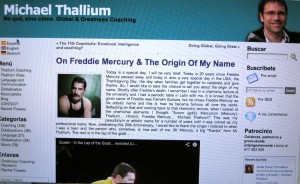 To mark the 20th Anniversary of Freddie Mercury’s death, I wrote a little post two years ago. In that post entitled On Freddie Mercury and the origin of my name I explained what the origin of my name is. Today, two years later, I want to remember the voice of Freddie Mercury on the occasion of the 22nd Anniversary of his death. 22 years gone by! To mark the 20th Anniversary of Freddie Mercury’s death, I wrote a little post two years ago. In that post entitled On Freddie Mercury and the origin of my name I explained what the origin of my name is. Today, two years later, I want to remember the voice of Freddie Mercury on the occasion of the 22nd Anniversary of his death. 22 years gone by!
One of my goals in life is that when anybody hears or reads the name Michael Thallium they immediately associate it with four main areas: coaching & transleadership —this last term I learnt it from pioneering Jennifer Sertl—, music, communication and globalisation.
Since one of my missions in the field of coaching and transleadership is to help others find their “voice” —not particularly in music, but in their lives and careers—, then let’s remember Freddie Mercury’s voice today and let’s get inspired to evolve and help others evolve!
Michael Thallium
Global & Greatness Coach
Book your coaching here
You can also find me and connect with me on:
Facebook Michael Thallium and Twitter Michael Thallium
|
|