
Sorry, this entry is only available in Español.
|
Sorry, this entry is only available in Español.
I have listened to the six string quartets just once over the last two days. And I can say that I started to become engaged with Martinu’s music when I reached quartet no. 3. For some reason, I found quartets numbers 3, 4, 5 and 6 more appealing to my ears. That does not mean I do not like the two first quartets. The first quartet, known as The French Quartet because of the influence of Debussy and Ravel on Martinu, is the one I like the least, but that only has to do with my personal taste, I guess. I am not very keen on Debussy’s music. Quartet no. 2 was a game changer for Martinu and I think you can tell when you listen to the complete string quartets. Bohuslav Martinu wrote almost 400 works. He was a very prolific composer, but he still remains unkown for most people. And I am sure among all of his works there will be masterpieces for us to enjoy. And this is why I decided to write this short article: to encourage you to discover his music, especially if you are not yet familiar with his music. Michael Thallium Global & Greatness Coach You can also find me and connect with me on: Facebook Michael Thallium and Twitter Michael Thallium
Now, some years later, and assuming the hypothesis that there is such a thing as human greatness, I’ll dedicate the next three months to capture that greatness and, in due course, I’ll share it on this website. In order to do that, I’ll use my camera and pen. Anyone who would like to contribute with ideas or images representing the greatness of human being, please do so by leaving a comment on this blog or getting in touch with me by email, Skype, Facebook or Twitter. Let’s get down to work! Michael Thallium Global & Greatness Coach You can also find me and connect with me on: Facebook Michael Thallium and Twitter Michael Thallium
Interpretations are free and, maybe, too many. As many as people on this planet, as many as the mood those people are in. When I look at a drawing or painting, when I listen to a piece of music, I constantly have to remind myself of that subjectivity: Is this really what the artist wants to say at all? We tend to forget what’s behind the scenes. There’s always a human being behind the scenes, the creator of that work of art. A human being, a person, with all their particular life experience, feelings, emotions and expectations. A person whose life we will hardly ever fathom…
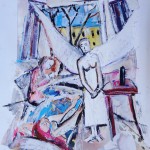
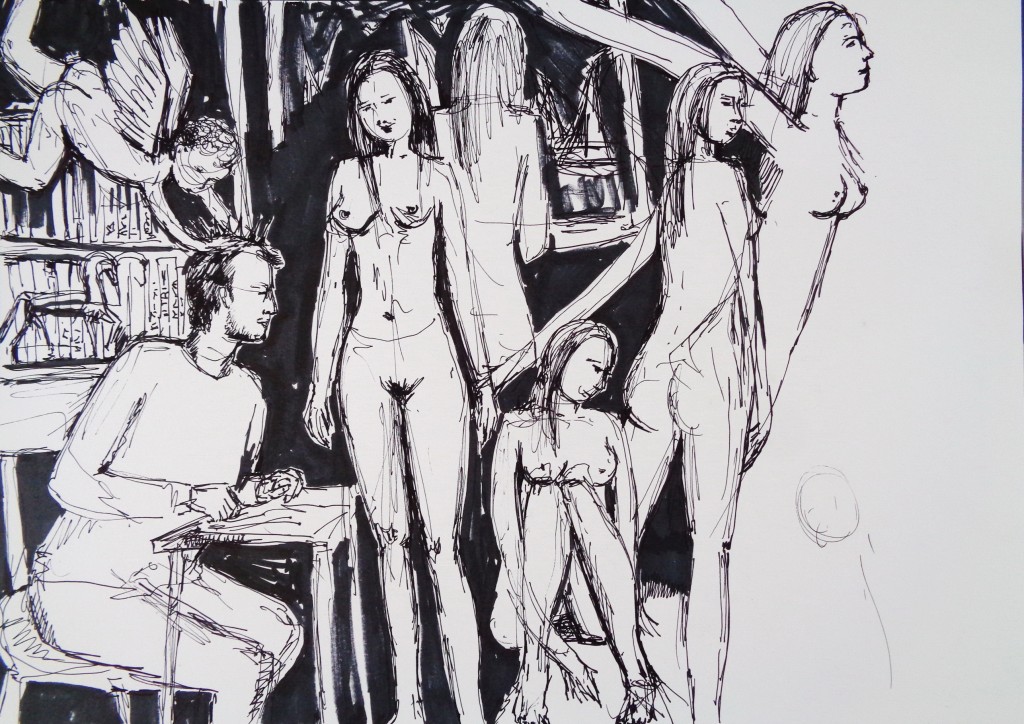 "Love Tomorrow", ink pen, mixed media by Elisaveta Sivas Love tomorrow… that’s the title of a drawing and collage by Elisaveta Sivas. What do I see when I look at this black and white drawing? I see a man sitting there, looking at a woman. That man could be me. It’s me thinking about love, gazing at that woman. That woman is staring at me. She wants me to see her. She is naked, showing her beautiful body. It’s as if I would just want to stand up and stop contemplating to make that scene real, to make love today, now, not tomorrow. And there are also many women within that one woman. She is struggling. She wants to be with that man, but at the same time she turns her back. She sits and turns her head. She wants to break free, open to spirituality. However, she also wants to experience her eros, her primitive sexuality. That man sitting there, me, is crowned by an angel. I have all devine blessings to love that woman. But it takes action. It takes two, though, to meet. Sitting there, there’s no love today, but maybe tomorrow. A constant tomorrow that never comes…
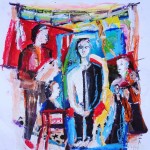
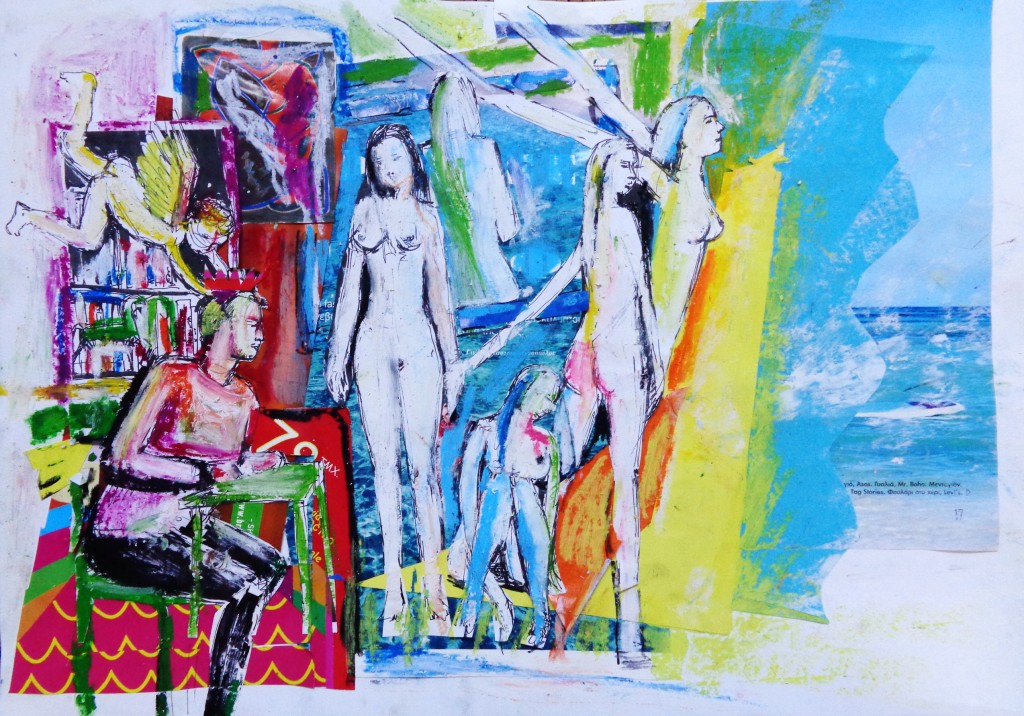 "Love Tomorrow (in colour)", paper collage, mixed media by Elisaveta Sivas And then you have the colour that blurs all that primitive sexuality. Colours bring about joy and lots of new nuances that may hide that sexual urge so present in black and white. Life is not just black and white. It’s colourful. But black and white are colours not to be ignored. Did you notice that little horse in front of the books on the shelf? What would that mean? A horse? Is it maybe emotions (horse) covering intelectuality and knowledge (books)? It’s all about different worlds which want to come together. The emotions want to pervade the intelectuality and knowledge. Intelectuality and knowledge may be preventing the man (me) from standing up and joining the woman. The man (me) wants to love, in black and white and in colour, that woman. All those women who form that one beautiful woman standing and staring at me, they all have to come together as well in order to become the bride of a man crowned by the devine angel. Emotions, intelectuality, knowledge, man and woman, they all will have to overcome their fear of today to make that “love tomorrow”, love today, now. I said interpretations are free and too many. And I know it’s impossible for me to fully fathom the inner worlds of an artist, of a person. But I can always work out my interpetation to make “now” be eternal, to make “today” be the eternal love that comes tomorrow… Remember: this man could also be you looking at that drawing, reading these words and interpreting the many worlds we live in. And that woman? That woman is love today and ever. Michael Thallium Global & Greatness Coach You can also find me and connect with me on: Facebook Michael Thallium and Twitter Michael Thallium
MORE WORKS BY ELISAVETA SIVAS:
Sorry, this entry is only in Spanish… but you’re more than welcome if you’d like to translate it into English or any other language Sorry, this entry is only available in Español.
When I first arrived in Hamburg –I think it was around 1991–, I had the feeling of belonging to that Hanseatic city. It was as if I had ever been there before. For me it was also the first time I went out of the country I was born, Spain. This, of course, if I don’t count my visits to the south of Portugal with my parents as a child —I don’t know why, but I think Spanish people, at least me, we consider that going to Portugal is not going abroad. Obviously, back then I didn’t know that the familiarity raised in me by the city of the Alster lakes would have any kind of link, if any, with my musical listenings later in my life. Strangely enough, over the years, those musical listenings have taken me back to the origins of my first adventure abroad. It is as if all those endless walks I took around the city —strolling around beautiful cemeteries, going through backstreets most German locals wouldn’t dare to pass through, gazing at the waters of the immense Elbe, walking in the churches to listen to organ music— would have been the prelude to all those “musical walks” I have taken over the years by listening to the music of different composers. Those recordings, for some reason, have been linked to the city where, paradoxically, there are no “hamburgers”. What we call ‘hamburger’, it is called Frikadelle by the Hamburgers (it was the German immigrants arriving in the United States at the end of the 19th century who introduced a dish that the Americans called ‘Hamburg steak’; then it became ‘hamburger’ or its short form ‘burger’). So, if you really want to try the authentic “hamburger” in Hamburg, you need to ask for a Frikadelle in one of the many street food stalls or restaurants. It was precisely in Hamburg where Barthold Heinrich Brockes (1680-1747) was born five years before Johann Sebastian Bach was born in Eisenach. Brockes died in Hamburg three years before Bach would die in Leipzig. Brockes was a writer, a poet and a politician of the beginnings of the German Enlightenment. As a young man, he travelled extensively to Italy, France and the Netherlands. He was a member of the Hamburg senate and an imperial count palatine. Brockes fought for women’s emancipation through education. In 1712, he wrote a poem entitled Der für die Sünden der Welt gemarterte und sterbende Jesus (The Story of Jesus, Suffering and Dying for the Sins of the World), known as the Brockes Passion. It is an oratorio in verse, very popular in its time, which was set to music by many composers. Among those composers, I want to highlight three of them: Reinhard Keiser (1674-1739), Georg Philipp Telemann (1681-1767) and Georg Friedich Händel (1685-1759).
At the same time as Telemann, but much farther away from Hamburg, Georg Friedich Händel was composing his version of the Brockes Passion in London. Händel was the most international of the three composers. Born in Germany and naturalized in The chronological order of these three pieces corresponds, in this case, to my order of preference as well: Keiser, Telemann and Händel. The three musicians, for different reasons, are linked to the city where there are no “hamburgers”. And although Johann Sebastian Bach didn’t work in Hamburg and neither set he the poem of Barthold Heinrich Brockes to music, this city will indirectly remain linked to Bach by winds of fate: Telemann was the godfather of Carl Philipp Emanuel Bach, the son of Johann Sebastian Bach, and when Telemann died in 1767, his godson replaced him as a music director of the five most important churches of the City of the Elbe. Who knows, maybe J. S. Bach also thought: Half a ‘hamburger’ is better than none! Michael Thallium Global & Greatness Coach You can also find me and connect with me on: Facebook Michael Thallium and Twitter Michael Thallium According to the sentence “the more I listen to, the more it remains to be listened”, it is clear to me that I will have no time to listen – understand, fathom – to everything I would like to. I can only aspire, if that is an aspiration, to enjoy what my brain allows me to listen to. That said, I realised that the same way you have to dedicate your time and your attention to understand things, to enjoy them, you have to dedicate time and attention to people as well. In this world of the 21st century in which people seem to have less and less time to enjoy, I have decided to make up a noun and its corresponding verb: tempotention and to tempotend. Tempotention: it is the time and attention of quality dedicated to people for them to evolve happily. It is a concept that arises in a changing world in which everything seems to change rapidly and in which something maybe valid in a certain moment to be wrong in the next. The only thing invariable is the time and attention you have to dedicate to others for their personal development and empowerment as human beings. The less your tempotention, the less your personal development. Tempontend: dedicate time and attention of quality to others so that you contribute to their happiness and personal development. Most probably the usage of these terms will never go beyond the borders of this article. Just a reflection anyway: people need time and attention… always. Michael Thallium Global & Greatness Coach You can also find me and connect with me on: Facebook Michael Thallium and Twitter Michael Thallium Some four years ago, I started with an experiment on empathic listening that has led me to walk down unexpected paths. My intention was to see the effect music could have on the brain and check if you can enhance your empathic listening to people by listening to music. I must confess that failing at getting some “guinea pigs”, the only subject of my experiment was muggins here. In other words, I myself played the guinea pig, and this may make the result even more subjective and, therefore, lacking the scientific rigor that characterizes a lab experiment in which a lot of subjects take part. Notwithstanding, since half a loaf is better than none, I preferred to take the risk and get a knock rather than loafing about. At first, my experiment was limited to listening, over a period of nine months, to the two books of “The Well Tempered Clavier” by Johann Sebastian Bach and the 32 piano sonatas and nine symphonies by Ludwig van Beethoven. It was something relatively easy in principle: a month dedicated to each symphony, a piano sonata per week and some two preludes and fugues per week. The point is that when you want to fathom things, you start connecting the dots and then one thing leads you to a different one. So much so, that the experiment in question led me to dramatically expand my music collection and to listen to music I had never thought I would end up listening to. Music from the 8th to the 21st centuries. Over these four year period, I must have spent around 3,000 hours listening to music deliberately. And the more music I listen to, the more it remains to be listened. So, I am just content to enjoy what I listen to and forget about everything I will never be able to listen because my lifespan is limited. In the last two weeks I took to listening to music by a composer I had heard of a couple of times in the past. But I had never listened to any of his works. I am talking about the danish composer Carl Nielsen (1865-1931). So, I decided to buy — yes, I am one of those people who still buy music — the complete DACAPO edition of Nielsen’s symphonies and the clarinet, flute and violin concertos performed by the New York Philharmonic conducted by Alan Gilbert with soloists Nikolaj Znaider (violin), Robert Langevin (flute) and Anthony McGill (clarinet). I listen to each of the six symphonies twice and to each concerto once. It opened a relatively new world of symphonic sonorities. Although I recognise the quality of these works and the excellent performance of the musicians, however, for some reason, I just didn’t quite connect with Carl Nielsen’s music, despite he is one of the greatest symphonists in music history. That made me try and find out about new sound fields I could explore. Lo and behold, a new name appeared, a name completely unknown for me until a few days ago: Kalevi Aho. 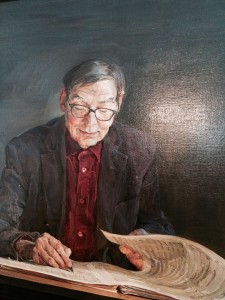 Kalevi Aho. Painting by Tuomas Vesala. Kalevi Aho is a very prolific Finnish composer born in 1949. He has written 16 symphonies to date and, over a three day marathon season, I have chronologically listened to each symphony once. I must say that I have discovered a new language with which I have connected from the very beginning. What is it that really makes us connect with things even though we do not fully understand them? None of Aho’s symphonies has ceased to amazed me. That is why I dare to say his music will endure in time. For anyone who is interested, the music label BIS publishes Aho’s music. The only three symphonies which are not recorded for BIS at the time I am writing these lines are No. 5 (I recommend the recording on Finlandia Records: Meet the Composer), No. 6 (you can find a poor quality audio version of this symphony on Youtube though) and No. 16 (on Youtube and with really good quality!). My discovery of Kalevi Aho has helped me confirm that there is always something new to be discovered and to connect with. This new “something” makes you see what you already know from a different perspective. In other words, it makes you rediscover the known with the enthusiasm of a child who sees, hears and feels something for the first time. In my case, music is the vehicle for personal development. Some other people may connect with painting, sports, dancing… I do not know if my ability to empathically listen to others has increased over these last four years. But no wonder my ability to venture new sound worlds and to open myself to the unkown has certainly increased. Who knows! Maybe someday there is even someone who analyses my brain and discovers that, indeed, all those hours of listening had their effect on my brain structure and on the way my neurons connect with each other. In the end, living may be rediscovering our reality over and over again, it may be establishing a continuous and changing synapsis with everything around us. Michael Thallium Global & Greatness Coach You can also find me and connect with me on: Facebook Michael Thallium and Twitter Michael Thallium |
|
|
|
Copyright © 2026 Michael Thallium - All Rights Reserved |
||
 With these words, Bohuslav Martinu (1890-1959) ushers us into the eclectic world of his six string quartets. I cannot say I am a connoisseur of Martinu’s music. My short affair with his music started some two years ago when I bought a CD of his symphonies no. 5 (H310) and no. 6 (H343) and his Inventions (H234) performed by the Czech Philharmonic Orchestra conducted by Václac Neumann on the record label
  The greatness of people… That’s one of the reasons why I decided to dedicate myself to coaching and language training. I believe in human potential. Certainly, there are moments when you have doubts about the validity of your principles and values. People, we, are capable of many things. Some of them are good, some others are bad. And it’s not easy to hold your ground and see people’s greatness when things around you seem not to match with the idea you have about greatness. When I decided to go freelance and dedicate myself to what I do, there were four areas I wanted to be known for, four areas I found that human greatness: language, music, globalization and coaching.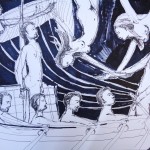


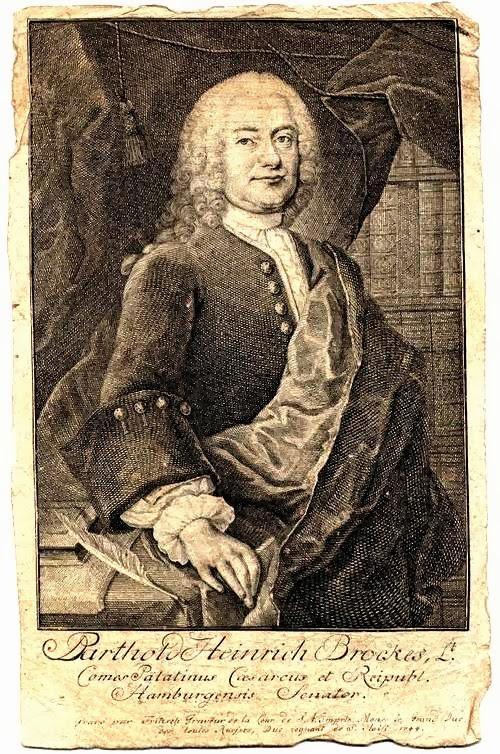 “The fool lives poor to die rich.” – B.H. Brockes
 Reinhard Keiser developed most of his career in Hamburg. A very prolifc opera composer —Johann Mattheson described him as “the greatest composer of opera in the world”—, Keiser may be the first one to set the Brockes Passion to music in 1712. His composition became a reference for many other composers who came along after him. His Passion was well performed by many, including Johann Sebastian Bach who lived hundreds of kilometres away in Leipzig. By the way, Bach never set the Brockes poem to music, because he was not allowed by the Leipzig Council —they wanted him to stick to the Biblical literalism. If I had to recommend a recording of this work by Keiser, no wonder that would be the Brockes Passion performed by the vocal ensemble
 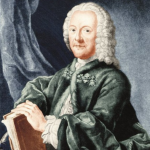 Four years later, in 1716, the most prolific composer of all composers in history, Mr Georg Philipp Telemann, was the one to set the Brockes poem to music. Back then, Telemann was working as a music director of the city of Frankfurt, around 500 km away from Hamburg. Five more years had to go by until Telemann definitively settled down in Hamburg, in 1721. He remained there until he died in 1767 —he only left the city for eight months, between 1737 and 1738, when he went on a trip to Paris. Telemman was a friend of Reinhard Keiser. As for Telemann’s Brockes Passion, the recording of reference for me is, undoubtedly, René Jacobs on
 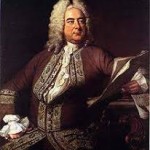 England, Händel travelled to Hamburg in 1703 where he was admitted to the Oper am Gänsemarkt (the present Hamburg State Opera) as a violinist and harpsichordist. It was there when he met Reinhard Keiser among other musicians. Then, Händel travelled to Italy and he even “italianized” his name: Giorgio Federico Hendel. There he took in the style of the Italian opera. In 1710, Händel returned to Germany as a director of music for the prince-elector of Hannover, who would later become George I of England in 1714. Händel settled down in England from 1712. The funny thing is that if you would ask a Briton to name a British classical music composer, they wouldn’t doubt to answer: Handel! Likewise, a German would say Händel is a German composer… Coming back to year 1716, the thing is that Händel composed his Brockes Passion in London. Then he sent the score to Hamburg, to the house of Barthold Heinrich Brockes, where most probably it was performed for the first time. Händel’s composition may be better known than Keiser’s and Telemann’s. For Händel’s Brockes Passion, the recording I recommend is the one on